
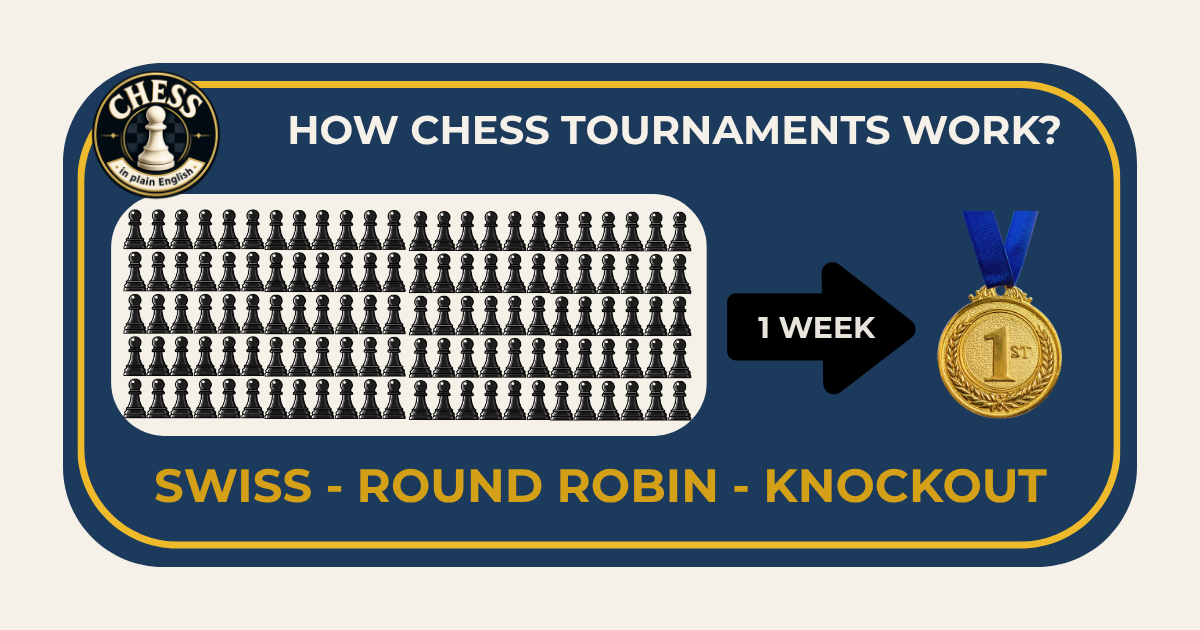
120 players enter a chess tournament. Within a week, there must be a winner — in a way that every player accepts as fair. After sitting in hundreds of tournament halls over the past decade, I can tell you: that is harder to solve than it sounds. Chess has developed three distinct answers to this problem, and each one has its place.
Contents
- Why tournament format matters
- Round robin — the fairest format in chess
- Why round robin does not scale
- Knockout — the most dramatic format
- The Swiss system — how most tournaments work
- Which format fits which event
Why tournament format matters
A chess tournament is not just a collection of games. It is a system designed to find the best player in the field within a fixed amount of time. The format — the rules that determine who plays whom and when — decides whether the result feels legitimate. Get it wrong and players leave feeling cheated. Get it right and the winner is the person who deserved it.
Whichever event you walk into — a club night, a weekend open, an invitational — the format was chosen deliberately, for reasons specific to that event’s size and purpose. A ten-player club championship, a hundred-player weekend open and an eight-player elite invitational cannot use the same rules and produce a fair result — the right format for one would be unworkable for the other two. The three formats used in chess are round robin, knockout, and the Swiss system. They solve the same underlying problem in completely different ways, and each one works best in a specific, fairly narrow context.
Round robin — the fairest format in chess
The most obvious solution is also the most fair. In a round robin, every player faces every other player exactly once. Whoever accumulates the most points wins. There is no pairing algorithm deciding who you face and no possibility of a soft schedule — the winner has beaten, or drawn with, the entire field. That is why round robin results carry more weight than any other format: nobody can argue they got an easy draw.
There is one complication: White moves first and has a proven statistical advantage. In a standard round robin, not every player gets the same number of White games. The solution is the double round robin — everyone plays everyone twice, once as White and once as Black. The Candidates Tournament, which produces the World Championship challenger, uses exactly this format: eight players, fourteen rounds, every colour played equally. Eight players are enough for a meaningful field, and few enough that a double cycle stays manageable.
Why round robin does not scale
Round robin has one fatal problem: mathematics.
Number of Rounds = Number of Players − 1
Eight players need seven rounds. Thirty players need twenty-nine. One hundred players need ninety-nine. A weekend tournament plays five to nine rounds in two or three days — a hundred-player round robin at that pace would take months, not a weekend, which is exactly why nobody uses it at that scale.
Round robin works wherever the field is small and fixed: chess leagues, elite invitationals, norm events of ten players, and Quads — where a large group is divided into pools of four and everyone plays everyone within their pool. All of these share the same trait: the organiser knows the exact field size in advance, and can set the number of rounds accordingly, well before anyone sits down to play. But for open tournaments with dozens or hundreds of participants, entering right up until the last moment, round robin is simply not viable — there is no way to fix the round count for a field that is still growing.
Knockout — the most dramatic format
Knockout is conceptually simple: lose and you are out. Win and you advance. Every game carries maximum stakes. As a spectator format, nothing beats it — the drama is real, the upsets are real, and tension compounds with each round. The Chess World Cup uses knockout for exactly this reason: a bracket of well over a hundred players narrowed down to a single champion.
Matches are seeded so the strongest players cannot meet in round one — top seed against bottom seed, working inward — which keeps the biggest clashes for later rounds, when the stakes are highest for everyone left in the draw.
The real cost of knockout is what it means for players who lose early. In a 64-player field, 32 players go home after round one. At an elite event, that is perhaps two years of qualification effort ended in a single round. At amateur level, it means paying an entry fee, travelling to the venue, losing on day one, and driving home. Would you come back to play that tournament the next year?
The Swiss system — how most tournaments work
Round robin does not scale. Knockout throws players out after one bad round. Swiss solves both problems at once: it runs at any size, and every player plays every round, win or lose.
There is no upper limit on field size. A ten-player club night and a thousand-player open both use the same system — the number of rounds does not need to grow with the number of players, the way it does in round robin. And nobody goes home early: the format guarantees a fixed number of games for everyone, which is exactly what knockout cannot offer.
The trade-off is precision. Round robin proves the winner beat everyone. Knockout proves the winner survived everyone. Swiss proves the winner performed best across a limited sample of opponents — and if that sample is too small, the result gets fuzzy. A large field played over only five or six rounds will often finish with several players tied on the same score, simply because there were not enough rounds to separate them. More rounds means more separation; fewer rounds means more ties. Organisers weigh this deliberately, balancing the number of rounds against the size of the field and the time available.
Read more about the Swiss System.
Which format fits which event
Round robin belongs wherever accuracy matters more than practicality: the Candidates Tournament, elite invitationals, chess leagues, norm events of ten players. Every result there is earned head-to-head, with nothing left to chance in the pairings.
Knockout belongs where spectacle and stakes matter as much as the result: the World Cup, and any qualification event built around the drama of elimination. It produces heroes and upsets in equal measure — and a long list of strong players who lost early and went home.
Swiss is the practical, everyday format — the one that makes large open tournaments possible without asking anyone to play a hundred games or leave after a single loss. It is the format you will encounter at almost every regional, national or open event you enter, from a Tuesday club night to a national championship. If this will be your first time, Your First Chess Tournament covers what to expect. If you have ever wondered why you ended up playing a particular opponent at a big weekend open, you were inside the Swiss system.
Why is the Swiss system used in most chess tournaments?
Swiss scales to any field size without needing everyone to play everyone. A hundred-player event only needs seven to nine rounds, not ninety-nine. That practicality is why it dominates open tournaments, while round robin and knockout stay reserved for smaller or invitational fields.
Why is knockout not used more often in chess tournaments?
Knockout eliminates half the field every round, so most players are out after one or two losses. That suits a made-for-television event like the World Cup, but it is a poor fit for weekend opens, where players are paying to play more than one game.
How many players can play in a round robin tournament?
In practice, round robin tops out around ten players. Beyond that, the number of required rounds becomes unmanageable — a 20-player round robin needs nineteen rounds, more than double a typical weekend event. That ceiling is exactly why Swiss exists for larger fields.
What format does the World Chess Championship use?
The match itself is head-to-head — a fixed set of games between two players. But qualification runs through all three formats covered in this post: round robin (the Candidates itself), knockout (the World Cup), and Swiss (the Grand Swiss) — each one feeding players into the same eight-player field.
What is a norm event in chess?
A norm event is a small round robin tournament, typically ten players, designed so that a player who performs above a threshold earns a norm — a step toward a chess title such as International Master or Grandmaster.
If you found this useful, join the Chess Dad list — chess in plain English, direct to your inbox.

