
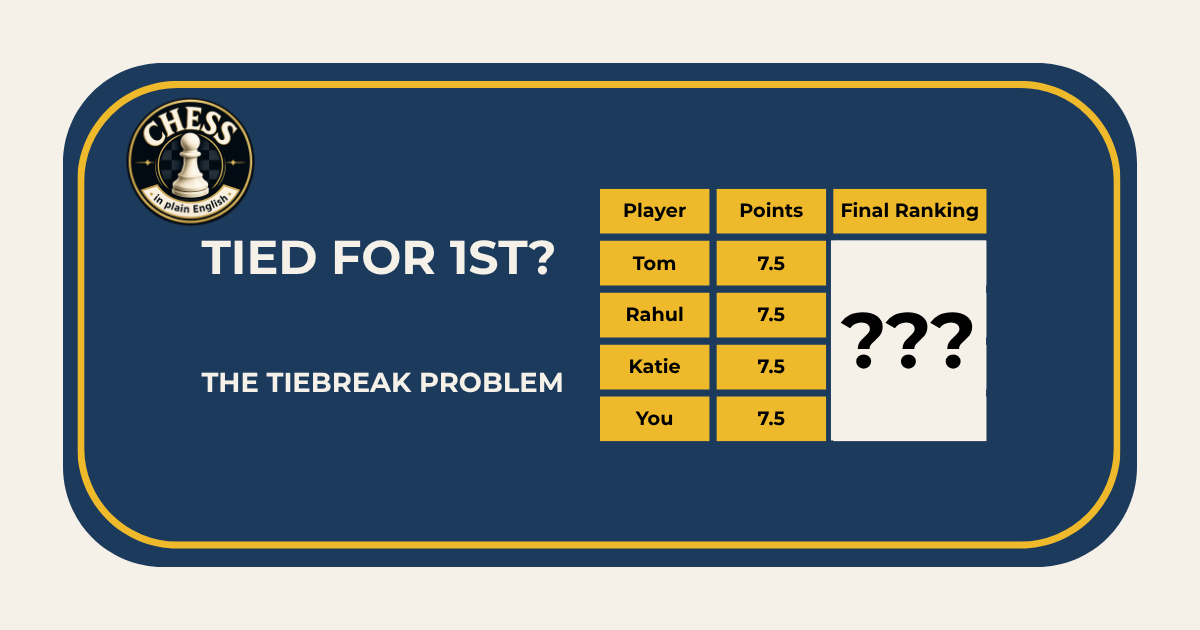
You finish a chess tournament tied for first. Whether you finish first, second, third or fourth depends on a game happening halfway down the hall between two players with no chance of winning the event. What is going on? This is the tiebreak problem — one of the most misunderstood parts of competitive chess — and it affects almost every tournament you will ever enter.
Contents
- Why ties are so common in chess
- The two approaches chess uses
- Playoffs — when chess plays on
- Head-to-head — the simplest formula
- Buchholz — the tiebreak you will encounter most often
- Sonneborn-Berger and the number of wins
- What this means for you at amateur level
The Tiebreak Problem: How Chess Decides Who Really Won
Why ties are so common in chess
Most chess tournaments run between five and nine rounds. That is simply not enough games to separate every player cleanly. In my experience, only around a third of Swiss tournaments end with a clear outright winner on points alone. Most end with two, three, or five players sharing the same score at the top. In the middle of the standings, ten to twenty players on identical scores is entirely normal. Ties are not the exception in chess — they are the rule. Which is why the game needed structured systems to resolve them, and why those systems became elaborate.
Adding more rounds would fix it mathematically, but nobody wants a two-week tournament. Organisers accept the trade-off: enough rounds to make the tournament practical, and a tiebreak system to sort out what the rounds themselves could not. That trade-off is the entire reason tiebreak systems exist at all — they are not an afterthought; they are a required part of it.
The two approaches chess uses
Chess has two fundamentally different ways to separate tied players. The first is playoffs — additional games played after the tournament ends. The second is tiebreak formulas — mathematical calculations applied to the results already on the scoreboard. Since 2022, FIDE requires that first place at top-level events be decided by playoff games rather than formulas. A game result is unambiguous: no formula, no paradox, no dispute. Formulas still determine second place and below even at elite events. At amateur level, playoff games are rare — time and logistics make them impractical, so formulas decide everything.
The 2022 change was a direct response to years of criticism — deciding a World Championship qualification spot by a spreadsheet formula, however carefully designed, never felt as legitimate as watching two players settle it over the board. Formulas remain the practical solution everywhere else, because playoff games need extra time, a free playing hall, and players willing to stay late after a long day of chess. For a club event finishing at 9pm on a Sunday, that is simply not realistic.
Playoffs — when chess plays on
At the World Championship, at the Candidates, at national championships with significant prize money — a disputed result is not acceptable. Playoff games use rapid or blitz time controls to produce a decisive result the same evening. If rapid games produce no winner, blitz follows. And if blitz still produces no winner, chess has one final answer: Armageddon. One game, no draws possible. White receives more time — typically five minutes to Black’s four — but White must win outright. A draw counts as a Black victory. Despite having less time, experienced players often prefer Black, because survival is enough to win the match.
Armageddon exists because rapid and blitz playoffs can themselves end in draws, and at some point the format has to guarantee a winner rather than simply try again. The asymmetry — less time but draw odds — is a deliberate design choice: it forces the player with White to take real risks to convert their extra minutes into a win, rather than simply playing it safe and offering a draw.
Head-to-head — the simplest formula
The simplest tiebreak formula compares the results of games between the tied players themselves. Whoever scored more points in those direct encounters ranks higher. With two players who met during the tournament, it is clean and immediately understood. The complication appears with three or more tied players — all of them must have played each other for the formula to apply. And it fails completely when results form a cycle: player A beat B, B beat C, C beat A. Nobody ranks higher. Head-to-head is useful as a first check but cannot be the only system.
This is why head-to-head almost never appears as the only tiebreak in a tournament’s regulations. It is usually listed first in a sequence, applied only when it can resolve the tie cleanly, with the tournament falling through to Buchholz or another formula the moment head-to-head cannot produce a clear answer. Reading a tournament’s tiebreak order before the final round tells you exactly which of your results will matter most if you finish level with someone else.
Buchholz — the tiebreak you will encounter most often
Buchholz is the most widely used chess tiebreak system. Developed by German organiser Bruno Buchholz in 1932, the principle is direct: your Buchholz score is the sum of all your opponents’ final scores in the tournament. Not your score — theirs. The logic: if you and another player finish on the same points but you faced stronger opposition to get there, your result was harder to achieve. Buchholz rewards playing well against a difficult section of the draw. The most common variant is Buchholz Cut-1, which removes your single lowest-scoring opponent — preventing one unlucky early pairing against a weak player from dragging down your tiebreak total.
Take two players finishing on six points each. One player’s six opponents finished with a combined thirty points between them. The other player’s six opponents finished with a combined twenty-four points. The first player’s Buchholz score is higher, so they rank above the second — even though both players won exactly the same number of games. It rewards the player who had the harder road to the same result, which is the entire logic the system is built on.
Sonneborn-Berger and the number of wins
Sonneborn-Berger works differently: every opponent you defeated contributes their full final score to your tiebreak. Every draw contributes half their score. Every loss contributes nothing. It rewards beating strong players specifically, which makes it well-suited to round robin events where everyone plays everyone. In Swiss events it produces uncomfortable outcomes — lose a critical game against the tournament leader and that game contributes zero to your Sonneborn-Berger total, despite being the hardest game you played.
A simpler alternative is counting wins. Two players on five points — one with four wins and two draws, the other with three wins and four draws. Number of wins ranks the first player higher. It rewards decisive play but ignores who you played. Both approaches have their applications, which is why tournament organisers choose from a menu of 28 different tiebreak systems currently supported in tournament software. Both systems are trying to answer the same underlying question — who really had the better tournament? But they weigh the evidence differently, which is exactly why organisers rarely rely on just one.
What this means for you at amateur level
At club and open tournaments, Buchholz will decide almost every tied result you encounter. Sonneborn-Berger appears occasionally as a secondary system. The others are rare. The most important practical point: your score always matters more than your tiebreak. Winning your last round counts for far more than finishing on the same score with a stronger tiebreak. A tiebreak only comes into play when scores are equal — so the first job is always to score. Understanding how Buchholz works helps you read a live standings table, but do not let tiebreak awareness distract you from the game in front of you.
Before your final round, it is worth a glance at the tournament regulations to see which tiebreak system applies — most organisers post this on the wall or the registration page. Knowing whether Buchholz or head-to-head decides your section changes nothing about how you should play the game in front of you, but it does mean the final standings will not come as a surprise.
What is Buchholz in chess?
Buchholz is the most common chess tiebreak system. Your Buchholz score is the sum of all your opponents’ final scores in the tournament. The idea is that playing against opponents who finish higher produces a stronger tiebreak than accumulating the same score against weaker opponents.
What is Armageddon in chess?
Armageddon is a single decisive playoff game used when all other tiebreak formats have failed to produce a winner. White receives more time on the clock but must win outright — a draw counts as a Black victory. It guarantees a definitive result.
How does chess decide a tie for first place?
At top-level events, FIDE now requires playoff games — rapid followed by blitz if needed, then Armageddon. At most amateur and open tournaments, mathematical tiebreak systems such as Buchholz are applied to results already on the scoreboard.
What is Buchholz Cut-1?
Buchholz Cut-1 is the Buchholz tiebreak with your single lowest-scoring opponent removed from the calculation. This prevents one unlucky early pairing against a player who then drops out or performs badly from dragging down your entire tiebreak total.
Why are there so many different chess tiebreak systems?
Each system was created to solve a specific flaw in an existing one. The chess world accumulated solutions over decades without standardising on a single approach. Tournament software today supports 28 different tiebreak systems, and different events use different defaults.
Leave a Reply