Category: Tournaments

How chess tournaments actually work: formats, pairings, tiebreaks, and what to expect at your first one.

  • Your First Chess Tournament

    Your First Chess Tournament

    Your First Chess Tournament: The Insider Guide

    Tens of millions of people play chess online and in schools. Only a fraction ever sits down at a real chess tournament board. That is a shame — because that is the best part of chess. Real pieces, real clock, real opponent across the table. Nothing online replicates it. I had no clue as a first-timer either. This is the guide I wish I had.

    Contents

    1. Choosing your first tournament
    2. Reading the registration page
    3. Preparing the day before
    4. Arriving at the venue
    5. Understanding pairings
    6. During the game — what surprises first-timers
    7. Between rounds
    8. The zero next to your name — and losing well

    Choosing your first tournament

    Start close and simple. The first decision is distance, venue quality, and timing. A tournament two hours away with a 9am round-one start has a real cost in stress and preparation — especially for your first event. The most important filter is the time control. Classical chess is the standard format for rated over-the-board chess. But each game takes hours. When I started playing over-the-board chess as an adult, I went to blitz and rapid events first. A club event with 20 players is a very different experience from a 200-player open. Start small.

    Ask at your local club, if you have one — they will know which nearby events are genuinely welcoming to first-timers and which are stronger fields best left for later. Look for language on the entry page like ‘all levels welcome’ or a dedicated unrated section; both signal an organiser who has thought about players in your exact position. There is no prize for choosing the hardest possible first event. The goal of tournament one is simply to have a good experience and want to come back for tournament two.

    Reading the registration page

    Tournament registration pages contain everything you need before you commit. The time control tells you how long each game will last and how your entire day is structured. Five rounds of 90+30 is a full weekend. Check which section fits you — most events divide players by rating range or age. If this is your first over-the-board event, you will be treated as unrated. Your Chess.com or Lichess rating carries little weight in the over-the-board world. Check whether national federation membership is required separately from the entry fee — some events need both, and that membership fee can be a surprise.

    Check the withdrawal and refund policy too — plans change, and knowing whether a late withdrawal costs you the full entry fee is worth two minutes before you pay. Most registration pages also let you request a bye for a round you cannot attend, which is standard practice and nothing to feel awkward about. Read the whole page once, fully, before entering any details. Missing a detail on page one is how people turn up on the wrong day with the wrong equipment.

    Preparing the day before

    Know your logistics before the morning of the tournament. Venue address, parking, what time round one starts, how long the journey takes. Build in buffer time. Arriving stressed is entirely avoidable and sets the wrong tone for the day. Sleep normally — a bad night’s rest costs games as surely as a tactical blunder. Pack the night before: two pens (one will disappear before round three), food and water for the full day, and dress in layers. Playing halls vary wildly in temperature. I came to one event in arctic-level cold-weather gear after freezing solid on day one. Hotel venues are usually comfortable. Schools and sports halls are unpredictable.

    If you are travelling any real distance, check the venue’s exact entrance — some tournament halls are tucked inside larger buildings, schools or sports centres, and finding the right door once you arrive can eat into your buffer time. None of this is complicated. It just needs doing the night before, not the morning of.

    Arriving at the venue

    Aim to arrive 15 to 30 minutes before round one. When you walk in, locate four things immediately: the playing hall, the registration desk, the pairings display, and the restroom. If you registered online, you may only need to show up before your first game — but some events ask you to confirm arrival at the registration desk by a specific time. The arbiter is there to help with any questions. Their job before the round starts is information. After the round starts, it is enforcement of the Laws of Chess.

    Use the extra minutes before round one to sit at an empty board, if the hall allows it, and get comfortable with the surroundings — the noise level, the lighting, the general rhythm of the room. Chat with your opponent or your neighbour — that takes some of the nervous feeling away. By the time your own pairing is called, the venue should feel familiar rather than strange.

    Understanding pairings

    The pairings tell you everything you need for your next game: board number, opponent, and your colour. White is always listed first, on the left. Find your name, confirm the board number, check your colour. Most events determine pairings using the Swiss system, matching you against a player with a similar score each round. Pairings are posted online, projected on a screen, or printed on the hall walls depending on the event. If your name is missing or incorrectly listed, find the arbiter immediately. Do not try to resolve it with your opponent alone — disputes at over-the-board events are the arbiter’s business.

    Pairings for round one are usually posted well before the round starts, giving you time to find your board without rushing. From round two onward, pairings typically appear shortly after the previous round finishes, once every game in the hall is complete — so there can be a short wait between rounds while the software or arbiter finalises the list. Get into the habit of checking pairings promptly each round. Also, wandering off for too long between games can mean missing the start of your next one. Unless round start time is fixed.

    During the game — what surprises first-timers

    The playing hall has one quality that surprises almost every first-timer: silence. No background noise, no notifications, no chat — just you, your opponent, the board, and the clock. For players used to the ambient sound of online chess, the silence is genuinely disorienting the first time. Four rules to know before sitting down: touch a piece with intention to move it and you must move it; press the clock with the same hand that moved the piece; do not say ‘check’ aloud; offer draws after your move, not before. Chess etiquette goes much deeper than these four rules — a full guide is coming soon — but these will get you through your first game without an incident.

    None of these rules exist to catch you out. They exist so that every player at every board is operating under the same expectations, without needing to negotiate etiquette game by game. Most arbiters are patient with genuine first-timers who ask before acting rather than after — if you are ever unsure what to do, it is always better to pause and ask than to guess.

    Between rounds

    When a game ends, rest, eat, and get some air. A chess tournament is more physically demanding than most first-timers expect — long periods of concentration are genuinely tiring. If there is an analysis room, use it. Replaying your game with your opponent immediately after it ends is one of the best learning habits you can build at any level. Talk to other players in the hallway or café. The chess community at real events is consistently friendly, and the conversations between rounds are often as valuable as the games themselves.

    Avoid the temptation to spend every break staring at your phone or replaying the game alone in your head. A short walk outside, even for five minutes, resets your concentration far more effectively than scrolling does. If your event runs multiple rounds in a single day, treat food and water as part of your equipment, not an afterthought — a tired, hungry brain makes worse decisions in the fourth hour of the day than in the first.

    The zero next to your name — and losing well

    If this is your first rated event, you will likely see a zero next to your name on the standings. That is your current rating — you do not have one yet. Depending on your results, you will receive your first official rating after the tournament. It usually appears on your national federation’s list before FIDE’s. The zero will disappear. And you will almost certainly lose games — perhaps all of them. The first thing you learn at over-the-board chess is how to lose. The last tournament I played, I finished on zero points. And it certainly wasn’t the first one with that type of score. Ignore results in your first events and focus on the experience. It gets better. Everyone who plays competitive chess started exactly where you are.

    Your first rating, once it appears, is simply a starting point — a number that will move in both directions many times over the years ahead. Nobody remembers their first tournament rating a decade later. What people do remember is whether they enjoyed the day enough to come back for the next one.

    Do I need my own chess set to play in a tournament?

    Usually not. Most tournaments provide sets and clocks at every board. Check the specific event’s details — some smaller events ask players to bring equipment — but this will always be stated on the registration page.

    What rating do I need to enter a chess tournament?

    No rating is required for most events. Every player starts as unrated. Most tournaments have an unrated or beginner section specifically for players without a national or FIDE rating. Your first tournament is how you begin building your rating.

    How long does a chess tournament last?

    It depends on format and rounds. A blitz event takes a few hours; rapid usually takes an hour per round. A classical weekend open typically runs over two or three days, with each game taking 3 hours on average.

    What happens if I lose my first game in a tournament?

    You continue playing. Chess tournaments are non-elimination — you play every round regardless of results. Losing in round one means you will be paired against another player who also lost, so you can expect it to become easier. The tournament goes on from there.

    What is the arbiter in chess?

    The arbiter is the official responsible for enforcing the Laws of Chess during a tournament — answering questions before the round and ruling on disputes once it starts. If anything happens during your game that you are unsure how to handle, call the arbiter.
    If you found this useful, join the Chess Dad list — chess in plain English, direct to your inbox.

  • Chess Tiebreaks Explained

    Chess Tiebreaks Explained

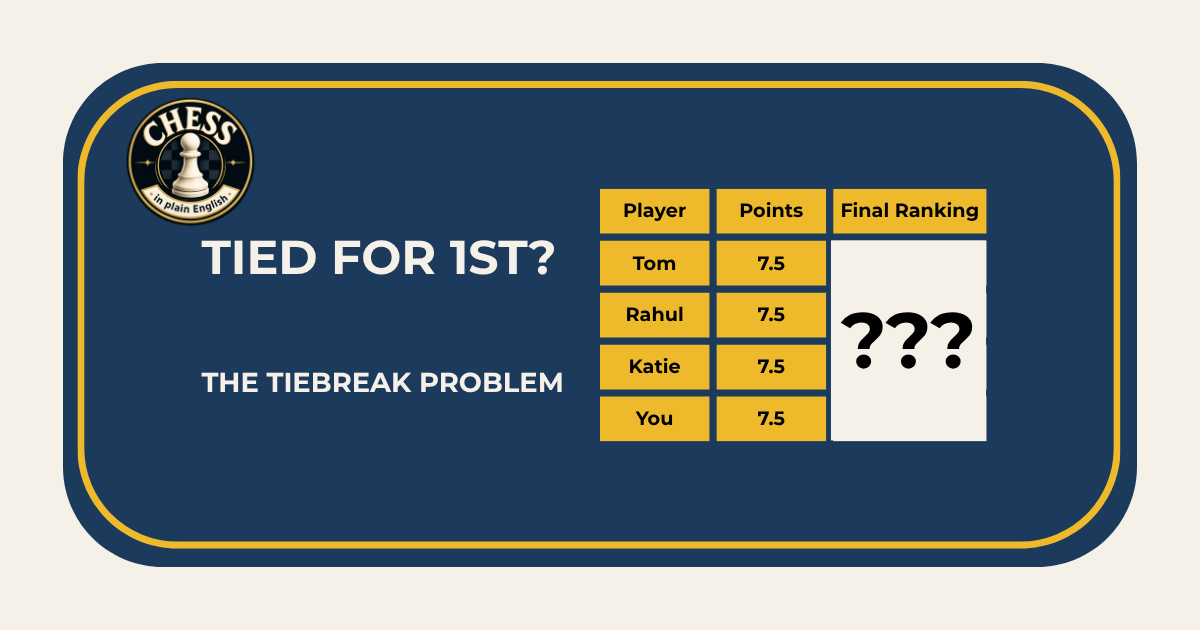
    You finish a chess tournament tied for first. Whether you finish first, second, third or fourth depends on a game happening halfway down the hall between two players with no chance of winning the event. What is going on? This is the tiebreak problem — one of the most misunderstood parts of competitive chess — and it affects almost every tournament you will ever enter.

    Contents

    1. Why ties are so common in chess
    2. The two approaches chess uses
    3. Playoffs — when chess plays on
    4. Head-to-head — the simplest formula
    5. Buchholz — the tiebreak you will encounter most often
    6. Sonneborn-Berger and the number of wins
    7. What this means for you at amateur level

    The Tiebreak Problem: How Chess Decides Who Really Won

    Why ties are so common in chess

    Most chess tournaments run between five and nine rounds. That is simply not enough games to separate every player cleanly. In my experience, only around a third of Swiss tournaments end with a clear outright winner on points alone. Most end with two, three, or five players sharing the same score at the top. In the middle of the standings, ten to twenty players on identical scores is entirely normal. Ties are not the exception in chess — they are the rule. Which is why the game needed structured systems to resolve them, and why those systems became elaborate.

    Adding more rounds would fix it mathematically, but nobody wants a two-week tournament. Organisers accept the trade-off: enough rounds to make the tournament practical, and a tiebreak system to sort out what the rounds themselves could not. That trade-off is the entire reason tiebreak systems exist at all — they are not an afterthought; they are a required part of it.

    The two approaches chess uses

    Chess has two fundamentally different ways to separate tied players. The first is playoffs — additional games played after the tournament ends. The second is tiebreak formulas — mathematical calculations applied to the results already on the scoreboard. Since 2022, FIDE requires that first place at top-level events be decided by playoff games rather than formulas. A game result is unambiguous: no formula, no paradox, no dispute. Formulas still determine second place and below even at elite events. At amateur level, playoff games are rare — time and logistics make them impractical, so formulas decide everything.

    The 2022 change was a direct response to years of criticism — deciding a World Championship qualification spot by a spreadsheet formula, however carefully designed, never felt as legitimate as watching two players settle it over the board. Formulas remain the practical solution everywhere else, because playoff games need extra time, a free playing hall, and players willing to stay late after a long day of chess. For a club event finishing at 9pm on a Sunday, that is simply not realistic.

    Playoffs — when chess plays on

    At the World Championship, at the Candidates, at national championships with significant prize money — a disputed result is not acceptable. Playoff games use rapid or blitz time controls to produce a decisive result the same evening. If rapid games produce no winner, blitz follows. And if blitz still produces no winner, chess has one final answer: Armageddon. One game, no draws possible. White receives more time — typically five minutes to Black’s four — but White must win outright. A draw counts as a Black victory. Despite having less time, experienced players often prefer Black, because survival is enough to win the match.

    Armageddon exists because rapid and blitz playoffs can themselves end in draws, and at some point the format has to guarantee a winner rather than simply try again. The asymmetry — less time but draw odds — is a deliberate design choice: it forces the player with White to take real risks to convert their extra minutes into a win, rather than simply playing it safe and offering a draw.

    Head-to-head — the simplest formula

    The simplest tiebreak formula compares the results of games between the tied players themselves. Whoever scored more points in those direct encounters ranks higher. With two players who met during the tournament, it is clean and immediately understood. The complication appears with three or more tied players — all of them must have played each other for the formula to apply. And it fails completely when results form a cycle: player A beat B, B beat C, C beat A. Nobody ranks higher. Head-to-head is useful as a first check but cannot be the only system.

    This is why head-to-head almost never appears as the only tiebreak in a tournament’s regulations. It is usually listed first in a sequence, applied only when it can resolve the tie cleanly, with the tournament falling through to Buchholz or another formula the moment head-to-head cannot produce a clear answer. Reading a tournament’s tiebreak order before the final round tells you exactly which of your results will matter most if you finish level with someone else.

    Buchholz — the tiebreak you will encounter most often

    Buchholz is the most widely used chess tiebreak system. Developed by German organiser Bruno Buchholz in 1932, the principle is direct: your Buchholz score is the sum of all your opponents’ final scores in the tournament. Not your score — theirs. The logic: if you and another player finish on the same points but you faced stronger opposition to get there, your result was harder to achieve. Buchholz rewards playing well against a difficult section of the draw. The most common variant is Buchholz Cut-1, which removes your single lowest-scoring opponent — preventing one unlucky early pairing against a weak player from dragging down your tiebreak total.

    Take two players finishing on six points each. One player’s six opponents finished with a combined thirty points between them. The other player’s six opponents finished with a combined twenty-four points. The first player’s Buchholz score is higher, so they rank above the second — even though both players won exactly the same number of games. It rewards the player who had the harder road to the same result, which is the entire logic the system is built on.

    Sonneborn-Berger and the number of wins

    Sonneborn-Berger works differently: every opponent you defeated contributes their full final score to your tiebreak. Every draw contributes half their score. Every loss contributes nothing. It rewards beating strong players specifically, which makes it well-suited to round robin events where everyone plays everyone. In Swiss events it produces uncomfortable outcomes — lose a critical game against the tournament leader and that game contributes zero to your Sonneborn-Berger total, despite being the hardest game you played.

    A simpler alternative is counting wins. Two players on five points — one with four wins and two draws, the other with three wins and four draws. Number of wins ranks the first player higher. It rewards decisive play but ignores who you played. Both approaches have their applications, which is why tournament organisers choose from a menu of 28 different tiebreak systems currently supported in tournament software. Both systems are trying to answer the same underlying question — who really had the better tournament? But they weigh the evidence differently, which is exactly why organisers rarely rely on just one.

    What this means for you at amateur level

    At club and open tournaments, Buchholz will decide almost every tied result you encounter. Sonneborn-Berger appears occasionally as a secondary system. The others are rare. The most important practical point: your score always matters more than your tiebreak. Winning your last round counts for far more than finishing on the same score with a stronger tiebreak. A tiebreak only comes into play when scores are equal — so the first job is always to score. Understanding how Buchholz works helps you read a live standings table, but do not let tiebreak awareness distract you from the game in front of you.

    Before your final round, it is worth a glance at the tournament regulations to see which tiebreak system applies — most organisers post this on the wall or the registration page. Knowing whether Buchholz or head-to-head decides your section changes nothing about how you should play the game in front of you, but it does mean the final standings will not come as a surprise.

    What is Buchholz in chess?

    Buchholz is the most common chess tiebreak system. Your Buchholz score is the sum of all your opponents’ final scores in the tournament. The idea is that playing against opponents who finish higher produces a stronger tiebreak than accumulating the same score against weaker opponents.

    What is Armageddon in chess?

    Armageddon is a single decisive playoff game used when all other tiebreak formats have failed to produce a winner. White receives more time on the clock but must win outright — a draw counts as a Black victory. It guarantees a definitive result.

    How does chess decide a tie for first place?

    At top-level events, FIDE now requires playoff games — rapid followed by blitz if needed, then Armageddon. At most amateur and open tournaments, mathematical tiebreak systems such as Buchholz are applied to results already on the scoreboard.

    What is Buchholz Cut-1?

    Buchholz Cut-1 is the Buchholz tiebreak with your single lowest-scoring opponent removed from the calculation. This prevents one unlucky early pairing against a player who then drops out or performs badly from dragging down your entire tiebreak total.

    Why are there so many different chess tiebreak systems?

    Each system was created to solve a specific flaw in an existing one. The chess world accumulated solutions over decades without standardising on a single approach. Tournament software today supports 28 different tiebreak systems, and different events use different defaults.

    If you found this useful, join the Chess Dad list — chess in plain English, direct to your inbox.

  • How Chess Tournaments Work

    How Chess Tournaments Work

    120 players enter a chess tournament. Within a week, there must be a winner — in a way that every player accepts as fair. After sitting in hundreds of tournament halls over the past decade, I can tell you: that is harder to solve than it sounds. Chess has developed three distinct answers to this problem, and each one has its place.

    Contents

    1. Why tournament format matters
    2. Round robin — the fairest format in chess
    3. Why round robin does not scale
    4. Knockout — the most dramatic format
    5. The Swiss system — how most tournaments work
    6. Which format fits which event

    Why tournament format matters

    A chess tournament is not just a collection of games. It is a system designed to find the best player in the field within a fixed amount of time. The format — the rules that determine who plays whom and when — decides whether the result feels legitimate. Get it wrong and players leave feeling cheated. Get it right and the winner is the person who deserved it.

    Whichever event you walk into — a club night, a weekend open, an invitational — the format was chosen deliberately, for reasons specific to that event’s size and purpose. A ten-player club championship, a hundred-player weekend open and an eight-player elite invitational cannot use the same rules and produce a fair result — the right format for one would be unworkable for the other two. The three formats used in chess are round robin, knockout, and the Swiss system. They solve the same underlying problem in completely different ways, and each one works best in a specific, fairly narrow context.

    Round robin — the fairest format in chess

    The most obvious solution is also the most fair. In a round robin, every player faces every other player exactly once. Whoever accumulates the most points wins. There is no pairing algorithm deciding who you face and no possibility of a soft schedule — the winner has beaten, or drawn with, the entire field. That is why round robin results carry more weight than any other format: nobody can argue they got an easy draw.

    There is one complication: White moves first and has a proven statistical advantage. In a standard round robin, not every player gets the same number of White games. The solution is the double round robin — everyone plays everyone twice, once as White and once as Black. The Candidates Tournament, which produces the World Championship challenger, uses exactly this format: eight players, fourteen rounds, every colour played equally. Eight players are enough for a meaningful field, and few enough that a double cycle stays manageable.

    Why round robin does not scale

    Round robin has one fatal problem: mathematics.

    Number of Rounds = Number of Players − 1

    Eight players need seven rounds. Thirty players need twenty-nine. One hundred players need ninety-nine. A weekend tournament plays five to nine rounds in two or three days — a hundred-player round robin at that pace would take months, not a weekend, which is exactly why nobody uses it at that scale.

    Round robin works wherever the field is small and fixed: chess leagues, elite invitationals, norm events of ten players, and Quads — where a large group is divided into pools of four and everyone plays everyone within their pool. All of these share the same trait: the organiser knows the exact field size in advance, and can set the number of rounds accordingly, well before anyone sits down to play. But for open tournaments with dozens or hundreds of participants, entering right up until the last moment, round robin is simply not viable — there is no way to fix the round count for a field that is still growing.

    Knockout — the most dramatic format

    Knockout is conceptually simple: lose and you are out. Win and you advance. Every game carries maximum stakes. As a spectator format, nothing beats it — the drama is real, the upsets are real, and tension compounds with each round. The Chess World Cup uses knockout for exactly this reason: a bracket of well over a hundred players narrowed down to a single champion.

    Matches are seeded so the strongest players cannot meet in round one — top seed against bottom seed, working inward — which keeps the biggest clashes for later rounds, when the stakes are highest for everyone left in the draw.

    The real cost of knockout is what it means for players who lose early. In a 64-player field, 32 players go home after round one. At an elite event, that is perhaps two years of qualification effort ended in a single round. At amateur level, it means paying an entry fee, travelling to the venue, losing on day one, and driving home. Would you come back to play that tournament the next year?

    The Swiss system — how most tournaments work

    Round robin does not scale. Knockout throws players out after one bad round. Swiss solves both problems at once: it runs at any size, and every player plays every round, win or lose.

    There is no upper limit on field size. A ten-player club night and a thousand-player open both use the same system — the number of rounds does not need to grow with the number of players, the way it does in round robin. And nobody goes home early: the format guarantees a fixed number of games for everyone, which is exactly what knockout cannot offer.

    The trade-off is precision. Round robin proves the winner beat everyone. Knockout proves the winner survived everyone. Swiss proves the winner performed best across a limited sample of opponents — and if that sample is too small, the result gets fuzzy. A large field played over only five or six rounds will often finish with several players tied on the same score, simply because there were not enough rounds to separate them. More rounds means more separation; fewer rounds means more ties. Organisers weigh this deliberately, balancing the number of rounds against the size of the field and the time available.

    Read more about the Swiss System.

    Which format fits which event

    Round robin belongs wherever accuracy matters more than practicality: the Candidates Tournament, elite invitationals, chess leagues, norm events of ten players. Every result there is earned head-to-head, with nothing left to chance in the pairings.

    Knockout belongs where spectacle and stakes matter as much as the result: the World Cup, and any qualification event built around the drama of elimination. It produces heroes and upsets in equal measure — and a long list of strong players who lost early and went home.

    Swiss is the practical, everyday format — the one that makes large open tournaments possible without asking anyone to play a hundred games or leave after a single loss. It is the format you will encounter at almost every regional, national or open event you enter, from a Tuesday club night to a national championship. If this will be your first time, Your First Chess Tournament covers what to expect. If you have ever wondered why you ended up playing a particular opponent at a big weekend open, you were inside the Swiss system.

    Why is the Swiss system used in most chess tournaments?

    Swiss scales to any field size without needing everyone to play everyone. A hundred-player event only needs seven to nine rounds, not ninety-nine. That practicality is why it dominates open tournaments, while round robin and knockout stay reserved for smaller or invitational fields.

    Why is knockout not used more often in chess tournaments?

    Knockout eliminates half the field every round, so most players are out after one or two losses. That suits a made-for-television event like the World Cup, but it is a poor fit for weekend opens, where players are paying to play more than one game.

    How many players can play in a round robin tournament?

    In practice, round robin tops out around ten players. Beyond that, the number of required rounds becomes unmanageable — a 20-player round robin needs nineteen rounds, more than double a typical weekend event. That ceiling is exactly why Swiss exists for larger fields.

    What format does the World Chess Championship use?

    The match itself is head-to-head — a fixed set of games between two players. But qualification runs through all three formats covered in this post: round robin (the Candidates itself), knockout (the World Cup), and Swiss (the Grand Swiss) — each one feeding players into the same eight-player field.

    What is a norm event in chess?

    A norm event is a small round robin tournament, typically ten players, designed so that a player who performs above a threshold earns a norm — a step toward a chess title such as International Master or Grandmaster.

    If you found this useful, join the Chess Dad list — chess in plain English, direct to your inbox.

  • How the Swiss System Works in Chess

    How the Swiss System Works in Chess

    How the Swiss system works in chess comes down to three rules that run almost every open chess tournament in the world — yet very few players who compete in one understand how the pairings actually happen behind the scenes. It was designed in 1895 by a teacher named Julius Müller for a tournament in Zurich, and it solved a problem that had no clean solution before: how to run a large event where every player plays every round, nobody goes home early, and the best player still rises to the top. Here is exactly how it works, round by round.

    Contents

    1. The three rules of the Swiss System
    2. Round one — how the Swiss system works in chess
    3. Round two — score groups take over
    4. Colour assignment — who gets White?
    5. Floaters — what happens when score groups are uneven
    6. Later rounds — how the system develops
    7. Why Swiss is not perfect — and why it is still used

    The three rules of the Swiss System

    The Swiss system runs on three rules, and everything else in this guide is simply those three rules working themselves out round by round.

    Rule one: no rematches. Two players can only meet once in the same tournament, no matter how the scores fall. This is the rule the pairing software checks first, before anything else — it can override colour balance if it has to, but it can never be broken.

    Rule two: players with equal scores play each other. After every round, you face someone who has the same result as you — winners play winners, players on half a point face other half-point players. This is what makes Swiss self-correcting: lose round one and your next opponent gets easier, not harder.

    Rule three: colour alternation. White and Black are balanced across rounds as evenly as possible. If you had White last round, you are due Black this round, and the pairing software tracks this for every player throughout the event.

    Three rules, in that order of priority. Every pairing you will ever see in a Swiss tournament is those three rules resolving themselves against a real field of players.

    Round one — how the Swiss system works in chess

    Before round one, every player is sorted by rating — strongest at the top, weakest at the bottom. Let me take ten players entering a Swiss tournament as an example. The field is split in half, and the top half plays the bottom half: seed one meets seed six, seed two meets seed seven, and so on down the list. Round one is the only round where rating alone determines the pairing — from round two, score takes over.

    Colours alternate by seeding: if the top seed has White, the second seed has Black, the third has White, and so on. Here is how that plays out for a ten-player field:

    BoardPairingWhite / alternate
    1Seed 1 vs Seed 6Seed 1
    2Seed 7 vs Seed 2Seed 7
    3Seed 3 vs Seed 8Seed 3
    4Seed 9 vs Seed 4Seed 9
    5Seed 5 vs Seed 10seed 5

    Pairings are set purely by rating, top to bottom. The only thing arbitrary is who gets White on Board 1. Sometimes this is settled with an actual draw of lots, an arbiter concealing a white pawn in one hand and a black pawn in the other for the top seed to pick. Just as often today, the pairing software decides it automatically the moment the field is set, with no ceremony at all.

    Round two — score groups take over

    After round one, players are regrouped by score, not rating — this is the shift that defines every round from here on. In a ten-player event where two games were decisive and three ended in draws, the field splits into three groups: two players on one point, six players on half a point, two players on zero.

    Each group pairs internally using the exact same method as round one: sort by rating, split the group in half, and pair the top half against the bottom half. The size of the group does not change the method — a group of two pairs the same way as a group of sixty, just with fewer players to sort:

    Score groupPlayersPairing logic
    1 point2The only pair in the group — one game
    ½ point6Split by rating: top 3 play bottom 3 within the score group
    0 points2The only pair in the group — one game

    From here on, score decides who you can face — rating only decides where you sit within that group.

    Colour assignment — who gets White?

    One principle governs colour assignment from round two onwards: the higher-rated player’s colour history takes priority whenever there is a genuine conflict. If two players in the same score group both had White in round one, both are technically due Black — but only one of them can have it. The higher-rated player’s preference wins: they get Black, and the lower-rated player gets White instead, even though the rule says they were both due the same colour.

    The same logic runs in reverse. If both players had Black in round one, both are due White, and again the higher-rated player’s preference is granted first.

    In the half-point group from our example, with six players involved, this gets applied player by player. Where a pairing naturally works out — one player due White, one due Black — the software uses it without needing to break any ties. Where both players in a pairing are due the same colour, the higher-rated player’s preference takes priority, and their opponent simply absorbs the mismatch instead.

    Floaters — what happens when score groups are uneven

    After two rounds, only one player is on two points in our example — having won both games. No other player shares that score, so there is nobody left in their score group to pair against. This is the moment a floater happens.

    Diagram showing how the Swiss system works in chess when a floater occurs

    The floating player drops down and plays the highest-rated player in the one-and-a-half-point group, provided the two of them have not already played each other earlier in the tournament. If that particular pairing would create a rematch, the algorithm skips to the next available player in the group below, and keeps checking until it finds someone who satisfies both the score-group rule and the no-rematch rule.

    Floaters happen constantly in Swiss tournaments — every uneven score group produces one. If you are ever paired against someone with a different score to you, this is not a mistake or a glitch in the software. It is the system doing exactly what it is designed to do: resolving an imbalance that is unavoidable.

    Later rounds — how the system develops

    In rounds three, four and five, the same three rules apply, but the score groups become steadily more refined as results pile up. Players near the top of the standings have faced increasingly strong opposition, because winning repeatedly pushes you into score groups with fewer and fewer players left in them. Players in the middle of the field are meeting opponents with genuinely similar records — which is usually where the closest, hardest-fought games of the tournament happen. The bottom of the draw consists mostly of players who have lost several games in a row and are now facing each other exclusively.

    By the final rounds, the leader and the second-place player will usually need to play each other directly — assuming they have not already met earlier — and that single game often decides the entire tournament. This is not a coincidence. The Swiss system is built so that the strongest performers rise through the score groups and collide with each other before the event is over, even though nobody planned that specific pairing in advance.

    Why Swiss is not perfect — and why it is still used

    The Swiss system has known limitations, and it is worth naming them plainly rather than pretending the format is flawless.

    The first is separation: with fewer rounds than players, several people will inevitably finish tied on the same score, because there were not enough games to tell them apart — which is exactly what tiebreak systems exist to fix. The second is complexity at scale: in very large fields, the pairing software occasionally cannot satisfy every rule for every player at once, and has to fall back on a fixed priority order instead.

    LimitationWhy it happensHow it is resolved
    Rounds too few to separate all playersFewer rounds than players means ties on score are commonTiebreak systems rank players after the event
    Pairing rules conflict in very large fieldsSoftware cannot satisfy all three rules at oncePriority order: avoiding rematches first, then score group, then colour

    None of these limitations have ever been solved better by another format at this scale — which is why Swiss remains the standard worldwide despite them.

    Why is it called the Swiss system?

    The Swiss system was designed by Julius Müller for a chess tournament held in Zurich, Switzerland in 1895. The name stuck and has been used ever since, even though the system is now used in chess tournaments around the world and has spread to other sports and games.

    Is the Swiss system the same as the Dutch system?

    Not exactly. Swiss is the broad category — pairing by score instead of elimination or round robin. Dutch is the specific pairing algorithm FIDE uses to run it, and by far the most common one worldwide. This guide describes how the Swiss-system tournament format works using the Dutch system.

    Why am I playing someone with different number of points?

    One of you floated — moved to a different score group because no opponent remained there. The higher scorer floats down, the lower scorer floats up. This happens with an odd number of players in a group, or when everyone left has already met. Normal, not an error.

    Can you get three consecutive White or Black games in a Swiss tournament?

    It is possible but uncommon. The system tries to alternate colours, but when no colour-balanced pairing is mathematically available within the same score group, the colour preference is overridden. Maintaining score group integrity comes first.

    What is a score group in Swiss chess?

    A score group is the set of players who have the same total points at a given point in the tournament. Swiss pairings are made within score groups — players with one point play other one-point players, and so on. Rating determines the order within each group.

    If you found this useful, join the Chess Dad list — chess in plain English, direct to your inbox.