
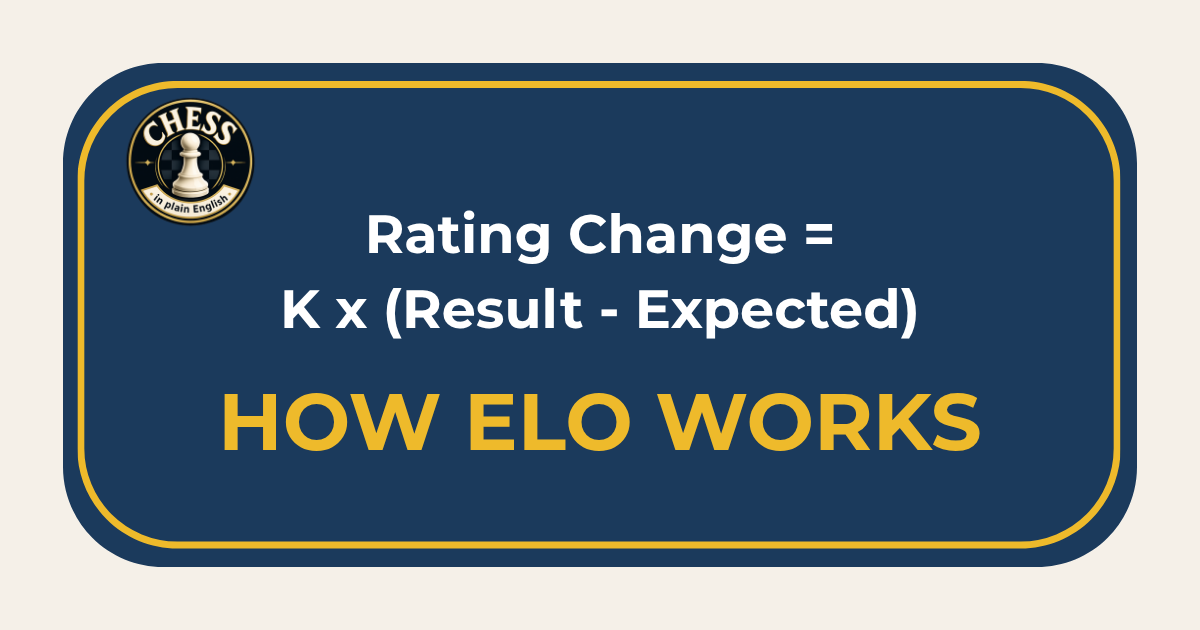
This guide has chess Elo rating explained the way it should have been the first time: no maths degree required. How does a player’s very first rating actually get calculated? How does one single game turn into points won or lost? Both questions have simple answers once the shape of the formula is laid out clearly, and this guide walks through exactly that — performance rating, the K-factor, and the man whose name the whole system carries.
Performance Rating: The Starting Point
Every player has a performance rating for any tournament they play — a snapshot of how strong their results looked in that specific event, calculated from the ratings of the opponents they faced and the score achieved against them.
A brand-new player’s very first official rating is built on exactly this idea. Seven opponents averaging a rating of 1525, with a score of exactly half the available points, produces a performance rating of 1525 — score more than half and the number sits higher; score less and it sits lower.
This same performance-rating concept resurfaces constantly throughout a competitive career, not just at the very beginning — it’s exactly how a strong single tournament result gets described even for a titled player, independent of what their overall rating happens to be at the time.
It’s a useful habit to check a performance rating after every tournament, win or lose, since it often tells a more honest story about the actual quality of play than the final rating change alone — a strong performance against tough opposition can still produce a modest rating gain, and that’s worth recognising in its own right.
The Rating Floor
To have an initial rating published at all, a new player needs a performance of at least 1400, calculated across a minimum of five rated games. That threshold isn’t arbitrary — it’s the line FIDE has drawn between an official rating and remaining unrated.
The 1400 floor doesn’t disappear once a rating exists, either. Drop below it later in a career, and the rating is deleted entirely rather than simply lowered, sending a player back to unrated status until they qualify again.
This is also why some genuinely talented new players wait to enter their first FIDE-rated event until they feel ready, since a very early result below the floor simply produces no rating rather than a discouraging low one.
The floor also means a single disastrous tournament early in a career carries less permanent weight than it might feel like at the time, since an unpublished rating simply leaves the door open to try again under better circumstances at the next available event.
Five Elements, One Game at a Time
Once a rating exists, it recalculates after every single rated game using five pieces of information:
- a player’s own rating,
- their opponent’s rating,
- the expected result based on both ratings,
- the actual result of the game,
- and a multiplier called the K-factor.
FIDE publishes an official calculator that runs this exact formula, so testing it with real numbers — a player’s own results, or a child’s — takes only a couple of minutes and turns an abstract idea into something concrete.
None of these five inputs are visible to a player mid-game, which is part of why the rating change after a tournament can occasionally feel larger or smaller than expected — the formula is working with precise numbers a player rarely sees in the moment.
Understanding these five inputs individually also helps explain why two players can walk away from the same tournament with very different feelings about their result — one may have played well against weaker-than-expected opposition, while the other faced a field that made a modest score look far more impressive on paper.
Expected Result and Surprise
An equal-rated draw barely moves either player’s rating, since it matches exactly what the formula expected. A big favourite winning as expected barely moves anything either — the system already predicted that outcome.
The real movement happens when a weaker player beats a stronger one. The bigger the surprise, the bigger the swing, and it’s always a direct trade: whatever one player gains in rating, the other loses in exactly equal measure.
This trade-off is precisely why a single upset can matter more for a young, fast-improving player’s rating than an entire tournament of expected results — the system is built to correct itself quickly whenever the data suggests it was wrong.
This is also the mechanism behind almost every well-known upset story in chess history — a lower-rated player who defeats a much stronger opponent doesn’t just win a single game, they force the entire rating system to sit up and take notice immediately.
The K-Factor
The K-factor decides how large a single game’s rating change can be, and it changes across a player’s career. New players use a K-factor of 40 for roughly their first thirty rated games, dropping to 20 once established, and down to 10 for players rated 2400 and above.
This means the exact same surprising result can swing very differently depending on who’s involved. A new player pulling off an unexpected win might gain far more points than a veteran would for the identical result, simply because their K-factor allows a bigger correction.
The K-factor tiers also mean two players in the very same game can have their ratings moved by very different amounts from the identical result. That is not only different but up to four times bigger change for one of them, with K factor at 40 vs 10.
A concrete example makes the gap easy to see: beat someone rated 400 points above you, and at K=40 you gain about 37 points, while at K=10 the identical win only gains 9. It cuts both ways within the same game, too — a rising junior still on K=40 beating an established Grandmaster on K=10 might gain around 26 points themselves, while the Grandmaster only loses about 6, for the exact same result.
Why Is It Called Elo?
Arpad Elo, a Hungarian-born physics professor and serious chess player himself, designed the rating system that carries his name. He built it to replace earlier, far less rigorous methods of ranking players by reputation and informal results.
FIDE officially adopted the Elo system in 1970, and it has remained the foundation of competitive chess rating ever since — extended and adjusted over the decades, but never fundamentally replaced.
Before Elo’s system, rankings were often decided by committee judgement and reputation rather than a consistent formula, which made it far harder to compare players across countries or even across different eras of the same national federation.
Elo’s original design was genuinely elegant in its simplicity — built from statistical principles rather than arbitrary point values, which is a large part of why it has survived, largely unchanged in its core logic, for more than fifty years.
Trying the Calculator Yourself
The clearest way to understand any of this is to actually run the numbers. FIDE’s rating calculator asks for opponents’ average rating, games played, and score achieved, then returns exactly what a performance or rating change would look like.
It’s a genuinely useful tool beyond curiosity, too — plugging in results partway through a tournament shows exactly what’s needed in the final rounds to hit a specific target, which turns an abstract number into something a player can actually plan around.
Coaches and parents alike tend to find the calculator most useful immediately after a tournament, cross-checking the official rating change against their own expectations — a good habit for understanding the system rather than just trusting the number that eventually appears.
Running a few hypothetical scenarios through the calculator before ever playing a rated game is also a genuinely good way for a complete beginner to build intuition for how the whole system behaves, well before their first real result ever gets submitted.
This builds directly on what a chess rating is, and leads naturally into why your rating is different everywhere.
Frequently Asked Questions
How is a player’s first chess rating calculated?
It’s based on performance rating: the average rating of their opponents, adjusted by the score achieved against them, calculated across a minimum of five rated games, using FIDE’s published formula.
What is the K-factor in chess ratings?
The K-factor is development, and it controls how large a single game’s rating change can be. New players use a higher K-factor, producing bigger swings, while established players use a lower one for smaller changes, reflecting greater confidence in their level.
Who invented the Elo chess rating system?
Arpad Elo, a Hungarian-born physics professor and chess player, designed the system. FIDE officially adopted it in 1970, replacing earlier, less rigorous ranking methods.
What happens if my rating drops below 1400?
FIDE’s 1400 floor applies throughout a career, not just at the start. A rating that later drops below 1400 is deleted entirely, and the player is treated as unrated again until they requalify.
Is there a calculator for working out rating changes?
Yes. FIDE publishes an official rating calculator that works out performance ratings and rating changes from opponents’ average rating, games played, and score achieved, making the formula easy to test with real numbers.
Leave a Reply