Author: Chess Dad

  • Chess Rules Etiquette: The Rules That Can Cost You a Game

    Chess Rules Etiquette: The Rules That Can Cost You a Game

    Chess rules etiquette catches most new tournament players off guard. An 8-year-old from my delegation lost a game at a European Championship only because he pressed the clock with the wrong hand twice. His parents told him to sit on his left hand for the rest of the tournament. In chess, you can lose a game because your phone rang. You can lose one because you touched the wrong piece. Many players learn these rules the hard way — in the middle of a tournament game. Here is both the formal and the informal: the rules enforced with defined penalties, and the expectations upheld only by the culture of the game.

    Chess rules etiquette: touch-move, the most important rule at the board

    Touch a piece with the intention of moving it and you must move it. No take-backs, no second thoughts, no undo button. Touch your opponent’s piece with the intention of capturing and you must capture it if a legal capture exists. The word that carries all the weight is intention. Accidentally knocking a piece while reaching for another is not touch-move — but you must be able to demonstrate the contact was unintentional. I once knocked my own king over three times in a single game, entirely by accident — my opponent looked over and joked that my position could not be that bad. Nobody called touch-move, because knocking a piece flat, repeatedly, is about as obviously unintentional as it gets. If you want to adjust a piece sitting off-centre on its square, say ‘j’adoube’ or ‘I adjust’ clearly before touching it. Both phrasings are valid under FIDE rules. One condition: say it on your own turn, before you touch the piece.

    The rule exists because chess without it would be unplayable at any competitive level — every hover, every hesitation over a piece, would become a live negotiation instead of a decision. Touch-move forces commitment, and that commitment is part of what makes chess a genuine test of judgement.

    How do you press the clock correctly?

    The sequence is always the same: complete your move and release the piece. Press the clock with the same hand that moved the piece. Then record the move on your scoresheet. Three steps, in that order, every single move. Common violations: pressing before releasing the piece; using the piece itself to press the clock; pressing with the wrong hand; hovering your hand over the clock while your opponent is thinking — this is considered intimidation and an arbiter can rule on it. Under five minutes remaining, you are generally no longer required to write down moves. When time is critical, the game takes priority.

    New tournament players often press the clock reflexively, out of habit from casual games at home where nobody enforces the sequence. Breaking that habit before your first over-the-board event is worth the effort — an arbiter correcting you mid-game over a clock violation is a distraction you can avoid entirely with a little practice beforehand.

    Illegal moves — what breaks the Laws of Chess

    An illegal move breaks one of the rules that define what a piece is allowed to do. The most common examples: a rook moving diagonally, a bishop jumping over another piece, castling through a square under attack, or simply leaving your own king in check without noticing.

    The Laws treat an illegal move as a mistake, not as cheating — but one with real consequences. The first illegal move earns your opponent two extra minutes on their clock, and the position is corrected back to what it was immediately before the error. A second illegal move in the same game is an automatic loss, regardless of the position on the board, even a completely winning one.

    When something goes wrong during a game, stop the clock and call the arbiter. Do not attempt to resolve it with your opponent alone — an illegal move, like leaving one’s king in check, is the arbiter’s business, not something to negotiate mid-game.

    Communication during play

    Do not announce check. Your opponent is expected to see it — this principle explains almost every communication rule in chess. If the board shows something, you do not need to say it. Audible reactions after a move — exclamations, comments, sighs — are poor etiquette and can be ruled as deliberate distraction by an arbiter. The playing hall is a silent space. Everything that needs to be communicated is communicated through the pieces.

    This extends further than most new players expect. Commenting on your opponent’s move, even something as small as a sympathetic sigh after a blunder, can be read as an attempt to influence their state of mind, and a watchful arbiter can act on it. The safest habit to build from your very first tournament is total silence at the board — no words, no visible reactions, nothing beyond the moves themselves. It feels unnatural at first if you are used to casual games with friends, where a running commentary is half the fun. At a rated event, silence is simply part of playing correctly.

    Draw offers — protocol and what to do if abused

    The correct sequence: make your move, offer the draw verbally, press the clock. Never offer before moving. Never offer on your opponent’s time. Your opponent can accept, decline verbally, or simply make a move — a move without comment is a declined offer. Every draw offer must be recorded on both players’ scoresheets. This is a requirement of the Laws of Chess, not a convention. That recording matters when offers become excessive. Repeated draw offers fall under FIDE’s harassment rules as deliberate distraction. If this happens to you, record every offer immediately. Two or three offers in a short sequence can already qualify. When you have documented enough, stop the clock, call the arbiter, and show the record.

    Most draw offers in club and open chess are entirely genuine and nothing to worry about — players offering a draw in a level position is completely normal. The protocol exists for the rare cases where offers are used to unsettle rather than to genuinely propose a result, and knowing the correct response means you are never caught unprepared if it happens to you.

    Phones and electronic devices

    Phones must be off or silent and not visible at the board. In most FIDE-rated events, a phone producing any sound during play is an automatic loss — regardless of whether you used it. I attended a tournament where a player’s phone was switched off in her bag and a repeating alarm activated mid-game. Her opponent called the arbiter. She lost on the spot. Switched off is not sufficient protection if an alarm is set. Keep phones as far from the board as possible. If you genuinely need your phone available — a medical professional on call, a family emergency — this can be arranged with the arbiter before the round starts. The arrangement must be made in advance.

    The strictness here surprises many first-timers, who assume a silenced phone in a bag is automatically safe. It is not, unless every possible sound — including alarms and notifications — is also disabled. The simplest solution is the safest one: leave your phone in your coat, your car, or switched off entirely in a bag well away from the board.

    The handshake and resignation

    A handshake before and after every game is expected at every level of competitive chess. Refusing is a reportable breach of etiquette. Before the game: set up pieces, shake hands, start the clock. After: result confirmed, handshake regardless of outcome. It is one of the oldest traditions in competitive chess. Shaking hands signals that both players accepted the contest as fair, whatever the result — win, loss or draw, the ritual is the same.

    When you resign, tip your king or say ‘I resign’ — any clear signal of resignation is accepted. Once you resign, the game is over and cannot be continued. Playing on indefinitely in a clearly lost position wastes your opponent’s time and is considered poor etiquette. But there is no obligation to resign the moment a position becomes difficult, either — plenty of hard-fought games are lost only after a real fight, and nobody expects you to give up while there is still a real fight to be had. The etiquette line is specifically about clearly lost positions: no material, no counterplay, checkmate simply a matter of time. That is the point where playing on stops being determination and starts being just annoying.

    Some players extend a hand as if resigning and say ‘Draw’ at the moment of contact — do not accept anything if this happens, stop the clock and call the arbiter. I have seen that — and I would not welcome that type of player anywhere. For me, this is a form of cheating.

    Sportsmanship

    Sportsmanship has no arbiter and no rule book. The chess community notices when it is absent, even when no formal rule is broken.

    People have asked me over the years — when your children play each other in a tournament, do they agree a draw? They never do. Even if one of them were about to win the national championship, the other would do everything in their power to beat them. They drew once when they were seven and eight years old — but only after three and a half hours with nothing left on the board but the two kings. I have also seen a different brother and sister in tournament chess obviously pre-arrange a draw — a game visibly agreed before it even started. It was not done to help either of them win a trophy. But the chess community noticed it and did not like it.

    None of this is written into the rating system or the prize table. It exists purely because chess is a small world, and a reputation for poor sportsmanship follows a player from club to club and tournament to tournament far longer than any single result does.

    What is touch-move in chess?

    Touch-move is the rule that if you touch a piece intending to move it, you must move it — and if you touch an opponent’s piece intending to capture, you must capture it if a legal capture exists. Accidental contact does not count, but you must show it was unintentional.

    What is j’adoube in chess?

    J’adoube is French for ‘I adjust.’ Saying j’adoube or ‘I adjust’ before touching a piece signals that you intend to straighten it on its square, not move it. It must be said on your own turn and before touching the piece.

    What happens if you make an illegal move in chess?

    The first illegal move earns your opponent two extra minutes on their clock and the position is corrected. A second illegal move in the same game is an automatic loss. This rule now applies equally across classical, rapid and blitz formats.

    What is the correct way to offer a draw in chess?

    Make your move, offer the draw verbally, then press the clock. Never offer before moving and never offer on your opponent’s time. Both players must record every draw offer on their scoresheets.

    Can your phone cost you a chess game?

    Yes. In most FIDE-rated events having your phone visible or producing any audible sound — ringtone, notification, alarm — during play results in an immediate loss regardless of whether you used it. This applies even if the phone is switched off but has an active alarm set.

    FAQ

  • Chess Fair Play: Cheating, Detection and What Gets You Expelled

    Chess Fair Play: Cheating, Detection and What Gets You Expelled

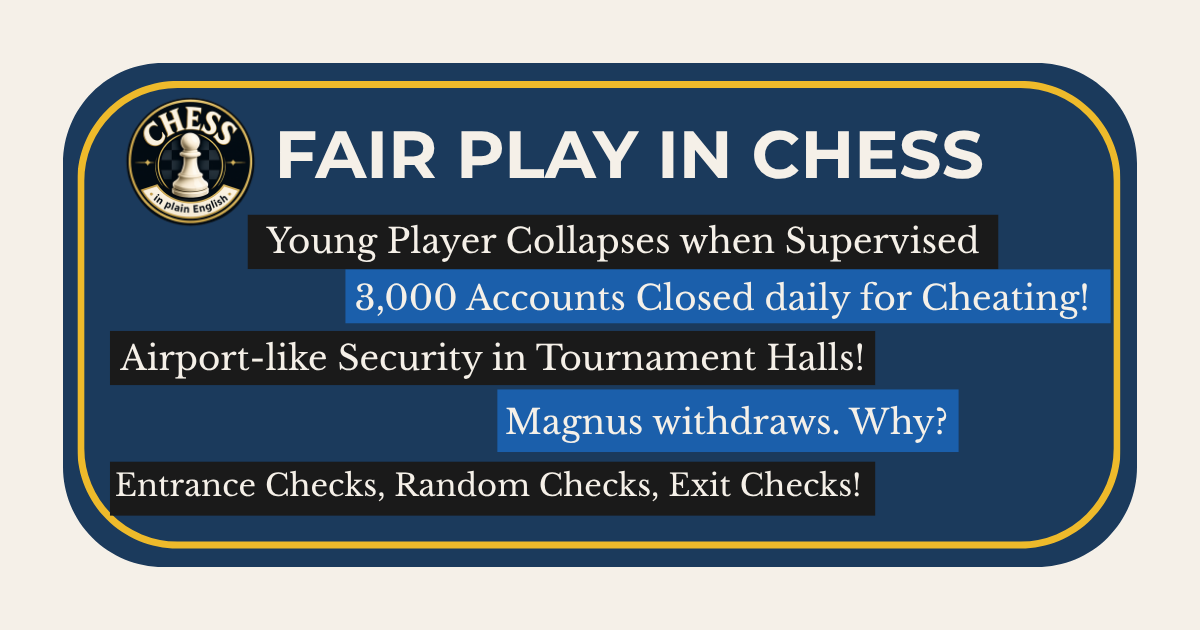
    Chess fair play is under real strain. My son came second in a tournament that another young man had won — a player who performed significantly above his rating. At the next event he entered, the arbiter grew suspicious and closed the door to spectators. The player collapsed in a few moves and was expelled permanently.

    Chess.com closes thousands of accounts every single day for fair play violations. This is the reality of chess integrity today.

    Four levels of chess conduct

    Chess conduct operates on four levels, each building on the one below. Integrity — the foundation of chess fair play — is what this article covers. Above it are formal rules enforced with defined penalties by an arbiter. Above that is etiquette, expected but not formally enforced. At the top is sportsmanship, upheld only by the culture of the game. The line in chess is clear: studying with an engine between games is legal; using one during a game is cheating. Training harder than your opponent is legitimate; having a friend signal moves from the spectator area is not. Cheating is not just a rule violation — it is taking an unfair advantage over every player in the event who chose to compete honestly.

    Most players will never break a formal rule, let alone cheat outright. But almost every serious player has, at some point, brushed against the etiquette or sportsmanship layers — a sigh after a blunder, a slightly delayed handshake after a tough loss. Understanding all four levels helps you see cheating for what it is: not a grey area, but a clear, deliberate step below everything else on this list.

    Online cheating — the scale

    Chess.com closes 3,000 accounts per day for fair play violations. Not per month — per day. Lichess runs comparable detection systems. The method is almost always engine assistance: using a chess engine to select your moves during a game. The technical barrier is low — a second device, a browser tab, a third party feeding the moves. Both platforms run statistical systems that compare a player’s moves against engine output across multiple games. Unusually high correlation triggers a review. Neither platform publishes its exact methodology, because doing so would help cheaters evade detection.

    The scale of the problem is part of why online platforms invest so heavily in detection rather than relying on players to report each other. A system reviewing every game, automatically, catches far more than a community of players ever could on its own. Even so, detection is a constant arms race — as detection methods improve, so do the methods used to evade them, which is exactly why neither platform reveals how its systems actually work.

    Over-the-board cheating — how it works

    Over-the-board cheating requires a communication channel — a way to get engine recommendations from a device to the player at the board. Most often the tool is a concealed phone. Methods include vibrating devices giving coded signals, earpieces, accomplices in the spectator area, and bathroom visits with a hidden device. A story from chess in Ireland: an adult player became convinced his teenage opponent was cheating — visiting the toilet frequently and returning with a brilliant move each time. The adult followed the teenager, found him with a phone, and physically removed him. Result: the cheating player was expelled. But so was the adult who confronted him. The correct response is always the same — speak to the arbiter discreetly.

    Modern anti-cheating measures at serious events exist precisely because these methods are not hypothetical — they have all been used, and caught, at real tournaments. The arbiter is trained to notice unusual patterns: repeated bathroom visits timed suspiciously with difficult positions, a player who seems to consult something before returning to the board. Reporting a suspicion, quietly and through the proper channel, protects everyone in the event — including, ultimately, the player being suspected, if they turn out to be innocent.

    The Niemann-Carlsen affair

    In September 2022, Magnus Carlsen lost to Hans Niemann at the Sinquefield Cup and then withdrew from the tournament. He made no explicit accusation. The chess world understood the implication immediately. Niemann acknowledged cheating online twice as a teenager. Whether over-the-board cheating occurred was never conclusively proven. Niemann sued Carlsen, Chess.com, and others for defamation. The lawsuit was settled out of court. The affair forced a serious public conversation about anti-cheating infrastructure that the chess world had been deferring — and measures that had been discussed for years were accelerated.

    The case remains genuinely contested in the chess world. Niemann’s supporters point to the lack of proven over-the-board cheating; his critics point to the confirmed online history and the statistical anomalies Chess.com identified. Both things can be true at once — a confirmed past violation does not prove a specific later game was also compromised, but it does explain why suspicion followed him so quickly.

    Sandbagging and pre-arranged results

    Not all cheating involves engines. Sandbagging is the deliberate suppression of your rating — losing games intentionally to stay below a threshold and compete in sections where you are stronger than the field. Detection relies on patterns: sudden dramatic performance above rated strength, inconsistent results that do not follow a normal development curve. ★ I had exactly that pattern myself recently — a genuine rise, then a genuine dip — and neither had anything to do with sandbagging. That is exactly what makes it so hard to prove: a real slump looks statistically identical to a faked one.

    Pre-arranged results — agreeing a win, loss or draw before play begins — are most common in Swiss tournaments, where one player needs a specific outcome for a prize or title norm. Without direct evidence of intent, neither is easy to prove, which is why both remain among the most contested cases in fair play.

    Organisers watch for both using similar tools: results that only make sense if a specific outcome was needed for a prize threshold or title norm, and pairings between players with a history of suspiciously convenient results. Neither sandbagging nor pre-arrangement involves an engine, which is exactly why it falls outside the statistical systems built to catch cheating online and over the board — human judgement from arbiters and organisers still matters as much as any software.

    Anti-cheating at elite events

    I led the Irish delegation to European and World Junior Championships on several occasions. Before competition, heads of delegation receive a briefing from the Fair Play officer describing a two-layer system.

    The first layer is physical — checks at the entrance that feel like airport security, random checks during play and at the exit, no spectators in the playing hall, players unable to leave the playing area at any point with toilet facilities included for this reason.

    The second layer is analytical — after rounds, games from strong performers are reviewed, comparing moves against engine recommendations and flagging unusually high correlation. A strong result is not suspicious on its own. A strong result where moves consistently match engine best play is a different matter.

    The measures can feel excessive to players experiencing them for the first time — a young player asked to empty their pockets before a game can find it unsettling. But the alternative, an event where results cannot be trusted, is worse for every honest competitor in the room. Junior events take this particularly seriously, precisely because the players involved are still building their careers and their reputations.

    Chess fair play consequences — the escalation

    Confirmed cheating triggers a clear escalation. A first confirmed case results in a tournament ban and removal from the current event. More serious or systematic violations bring rating suspension — the player’s rating is frozen or withdrawn, preventing participation in rated events until the case resolves. At the top: permanent expulsion. A small number of players have received lifetime bans from FIDE or their national federation. Online platforms close accounts and adjust affected opponents’ ratings. Detection has improved significantly and continues to improve. The gap between what can be detected and what can be proven remains the place where the most difficult cases live.

    Reinstatement, where it happens at all, typically requires a period of ineligibility and, in some federations, a formal review before a player is allowed to compete again. For a young player, the damage often extends well beyond the ban itself — a confirmed case follows a player’s reputation through the chess community for years, in a way that is far harder to repair than the suspension itself.

    FAQ

    How does Chess.com detect cheating?

    Chess.com uses statistical systems that compare a player’s moves against engine recommendations across multiple games. Unusually high correlation — meaning your moves consistently match what a computer would play — triggers a review. The exact methodology is not published to prevent cheaters gaming the system.

    What security measures do chess tournaments use against cheating?

    At major events, this means two layers: physical checks at the entrance and during play, with no spectators allowed in the hall, and analytical review afterward, comparing strong performers’ moves against engine recommendations. Junior events take it just as seriously as elite ones.

    What happened in the Niemann-Carlsen alleged cheating case?

    In 2022, Magnus Carlsen withdrew from the Sinquefield Cup after losing to Hans Niemann, implying he suspected cheating without stating it directly. Chess.com’s report suggested Niemann had potentially cheated in over 100 online games. Over-the-board cheating was never proven. Niemann sued for defamation; the case settled out of court.

    What is the penalty for cheating in a chess tournament?

    Penalties escalate from a tournament ban for a first confirmed case, to rating suspension preventing participation in rated events, to permanent expulsion from FIDE or the national federation for the most serious cases. Online platforms close accounts and adjust affected opponents’ ratings.

    How do people cheat at chess?

    Mostly by getting engine assistance during a game. Online, that usually means a second device or browser tab feeding moves in real time. Over the board, it is most often a concealed phone, accessed during bathroom breaks — though vibrating devices and accomplices in the crowd are also used.

    If you found this useful, join the Chess Dad list — chess in plain English, direct to your inbox.


  • Chess Notation Explained: How to Read and Write Any Chess Game

    Chess Notation Explained: How to Read and Write Any Chess Game

    Chess notation is written into every opening line, every annotated grandmaster game, every engine analysis you will ever see. In any rated classical event, recording your moves is required by the Laws of Chess — it is not optional. Learn the system once and you can read any game ever played, from an 1851 immortal game to this week’s World Championship.

    Contents

    1. Why notation matters
    2. The board grid — files, ranks and square names
    3. Piece letters
    4. Writing pawn moves and piece moves
    5. Captures, check and checkmate
    6. Special notation — castling, promotion, which piece
    7. The scoresheet and PGN

    Why notation matters

    Algebraic notation is the language of chess, and there are three reasons every player needs it.

    First, it is required: in rated classical events you must record your moves on a scoresheet from the start.

    Second, it resolves disputes: whether a position has appeared three times — entitling a draw claim — or whether an opponent has offered draws excessively, the scoresheet is your evidence. Without it, those claims cannot be made.

    Third, it enables study: every opening line in every book, every annotated game in every database, every engine recommendation is expressed in notation. Without it, studying chess as it has been studied for 200 years is not possible.

    There is a fourth, more personal reason too: notation lets you keep a permanent record of your own chess tournament life. Every tournament game you play, recorded and saved, becomes part of a personal history you can return to years later — a resource no serious player, at any level, should throw away after the game ends.

    The board grid — files, ranks and square names

    The chessboard is an eight-by-eight grid and every square has a unique name. Columns run left to right from White’s side of the board — these are called files, labelled a through h, with a on the far left and h on the far right. Rows run bottom to top from White’s side — these are called ranks, numbered 1 through 8, with rank 1 nearest to White. A square’s name combines its file letter and rank number in that order. The bottom-left square from White’s perspective is a1. The top-right is h8. The name never changes regardless of which side of the board you are sitting on.

    It helps to picture the board from White’s seat even when you are analysing as Black — files and ranks are fixed to the board itself, not to whichever side you happen to be sitting on. Once file and rank become automatic, reading a full game transcript stops feeling like decoding and starts feeling like reading a sentence.

    Piece letters

    Every piece except the pawn has a capital letter:

    PieceLetter
    KingK
    QueenQ
    RookR
    BishopB
    KnightN — K is already taken by King
    PawnNo letter

    A move beginning with a capital letter is a piece move. A move beginning with a lowercase letter is a pawn move. That single distinction tells you what type of move you are reading before you process anything else.

    This distinction becomes second nature quickly, but it is worth drilling deliberately at the start. Look at any short sequence of moves and sort them mentally into piece moves and pawn moves before reading further — Nf3, e4, Bc4, d6 — piece, pawn, piece, pawn. Once you can do that instantly, the rest of notation is simply learning what comes after the letter, which is largely just naming the destination square you already know how to read.

    Writing pawn moves and piece moves

    A pawn move is written as the destination square only. e4 means a pawn moved to e4. d5 means a pawn moved to d5. Nothing more is needed. A piece move is the piece letter followed by the destination square. Nf3 means a Knight moved to f3. Bc4 means a Bishop moved to c4. Qd1 means the Queen moved to d1. Read them aloud as you write: ‘Knight to f3.’ ‘Bishop to c4.’ The notation is the instruction: piece, destination, done.

    One detail catches beginners: two pieces of the same type can sometimes both reach the same square, and in that case the plain notation above is not enough — a small addition is needed to say which piece moved, covered in the “which piece” section further down. For the vast majority of moves in a normal game, though, piece letter plus destination square is all you will ever need to write or read.

    Captures, check and checkmate

    A capture is marked with a lowercase x between the piece and the destination square. Nxe5 means a Knight captures on e5. For pawn captures, include the file the pawn came from: exd5 means a pawn from the e-file captures on d5. The file is not optional here — pawns have no piece letter, so the file is the only way the notation identifies which pawn made the capture. The captured piece is never named.

    Check is marked with a plus sign after the move: Qh5+ means the Queen moved to h5 and delivered check. Bxc5+ means the Bishop captured on c5 and delivered check.

    Checkmate is marked with a hash: Qxh7# means the Queen captured on h7 and it is checkmate. Both check and checkmate appear immediately after the move with no space.

    Reading a scoresheet with these symbols in place tells a story on its own, before you even set up the position. A game full of x symbols was sharp and tactical. A quiet game with few captures was likely a slower, strategic battle. Learning to read that shape at a glance is one of the small pleasures of knowing notation well.

    Special notation — castling, promotion, which piece

    Castling is the only move in chess that does not follow standard piece-and-square notation. Kingside castling is 0-0. Queenside castling is 0-0-0. Two zeros for short, three for long in handwritten games. Digital databases use O instead, so castling appears as O-O and O-O-O.

    Pawn promotion is the destination square, an equals sign, and the piece chosen: e8=Q means a pawn moved to e8 and promoted to a Queen. bxc1=N means a pawn from b file captured on c1 and promoted to a Knight.

    When two pieces of the same type can both move to the same square, the notation must specify which moved. Use the file of the piece that moved: Nbd7 means the Knight from the b-file moved to d7. If both pieces share a file, use the rank instead: R1e4 means the Rook from the first rank moved to e4. The notation is simply doing exactly what it always does: giving just enough information to remove any doubt about which piece made the move, and no more.

    The scoresheet and PGN

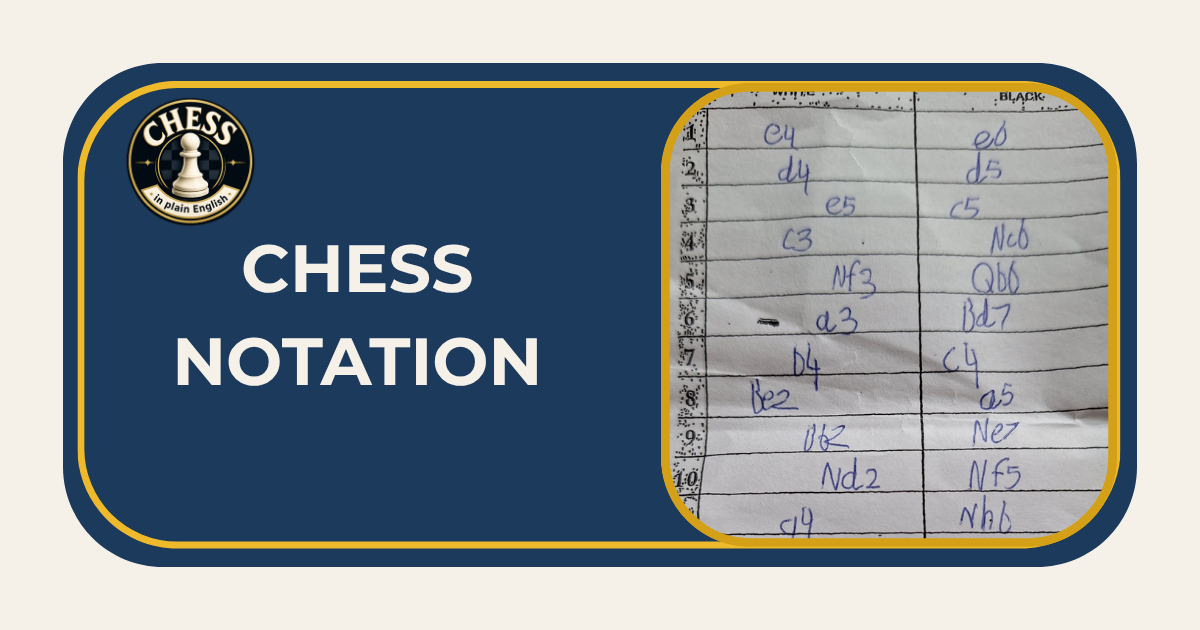
    A completed scoresheet records the full game in two columns: White’s moves on the left, Black’s on the right, move numbers on the far left. 1. e4 e5 means White played e4, Black played e5 on move one. The result appears at the bottom — 1-0 for a White win, 0-1 for Black, ½-½ for a draw. Both players sign each other’s scoresheets after the game to confirm the result. PGN — Portable Game Notation — is the universal digital format for storing chess games. Every major chess website and database uses it. Copy any game from any source and paste it into Chess.com, Lichess or ChessBase — it will be read immediately. Enter your own games over time and you build a personal database of your play, your patterns, your recurring mistakes.

    Most tournament software and chess apps can export or import PGN directly, so the game you played on a real board this weekend can be sitting in an online database, ready for engine analysis, within minutes of the round finishing.

    What is algebraic notation in chess?

    Algebraic notation is the standard system for recording chess moves. Every square has a unique name combining a file letter (a–h) and rank number (1–8). Moves are recorded using piece letters, destination squares and special symbols for captures, check, castling and promotion.

    Do I have to write down my moves in a chess tournament?

    Yes, in rated classical events. Recording moves on a scoresheet is required by the Laws of Chess, it is not a suggestion. You are exempt from this requirement when your remaining clock time drops below five minutes in most formats.

    How do you read chess notation?

    Nf3 means a Knight moved to the f3 square. N is the letter for Knight (K is reserved for King), and f3 is the destination — file f, rank 3. e4 means pawn moved to e4. Bxc5 means Bishop taking on c5 square.

    What is O-O or 0-0 in chess notation?

    O-O means kingside castling in digital databases — short castling. O-O-O means queenside castling — long castling. Two letter Os for short, three for long. Castling is the only chess move written with letters rather than piece and square. 0-0 and 0-0-0 is the same, but handwritten.

    What is PGN in chess?

    PGN stands for Portable Game Notation — the universal digital format for storing and sharing chess games. Every major chess website, database and engine reads PGN. A PGN file records the moves, players, event, date and optionally commentary.

    If you found this useful, join the Chess Dad list — chess in plain English, direct to your inbox.
  • How the Chess Clock Works: Increment, Delay, Rules and Penalties

    How the Chess Clock Works: Increment, Delay, Rules and Penalties

    Chess clock rules decide far more of a game than most players realise — the clock is the tool that made chess a sport in the first place. Before it appeared in the 1880s, games could last indefinitely; players took hours per move and some matches stretched across multiple days. The first mechanical clocks changed everything: thinking time became a limited resource, and chess became a game where both skill and time management determined the result.

    Contents

    1. From mechanical to digital chess clock
    2. Base time and increment
    3. Delay — how it differs from increment?
    4. Multi-stage time controls
    5. The correct sequence for pressing the clock
    6. What happens when you run out of time?
    7. Online clocks vs over-the-board

    Chess clock rules: from mechanical to digital

    The original mechanical chess clocks had two clock faces with a lever in the middle to switch between them. Each clock had a flag mechanism that fell when time expired — which is where the phrase ‘flag fall’ comes from, still used today even though modern clocks have no flags. These mechanical clocks ran on a single pool of base time with no addition. When it was gone, it was gone. Major FIDE events now require electronic digital clocks. Most rated tournament chess uses digital clocks, and seeing an analogue model at a rated event is increasingly rare.

    Digital clocks solved a problem mechanical clocks could never handle well: increment. Adding a few seconds back after every move requires the clock to track each move individually and calculate in real time — something a mechanical lever and two clock faces simply cannot do. That single limitation is the real reason digital clocks became mandatory at serious events, not just convenience or modernisation for its own sake.

    Base time and increment

    Base time is your starting pool of thinking time for the entire game. In a 90+30 control, 90 minutes is the base. When your clock reaches zero, the game ends in a loss regardless of the position. Increment is the most important clock innovation in chess history. It adds seconds to your clock after each completed move. In a 15+10 game you receive 10 seconds back every time you press the clock. With increment you can never run out of time as long as you keep moving. Before increment became standard, over half of all decisive games ended in time loss rather than checkmate. Increment is also called Fischer time, after Bobby Fischer who popularised it.

    This is why increment transformed the character of time trouble. Before it existed, the last few minutes of a long game often turned into a frantic scramble with almost no thinking involved. With increment, a player can still calculate properly even with little time on the clock, because every move buys back a few seconds of breathing room.

    Delay — how it differs from increment?

    Delay works differently from increment. Instead of adding time after your move, the clock pauses briefly before counting down. With a 5-second delay: move in 2 seconds and those 2 seconds are restored. Move in 8 seconds and only 5 are restored — you lose 3 seconds net. Time can never go up with delay, only stay the same or fall. The key difference from increment: delay prevents time loss for fast play but you cannot build a time reserve. Delay is named after Grandmaster David Bronstein who proposed it. In practice, delay is rarely used today — almost all modern tournament chess uses increment instead.

    Delay was popular in the United States for years, particularly in scholastic chess, partly because early digital clocks supported it before increment became standard. Today, if you see delay at all, it is most likely on an older clock model still in circulation at a smaller club rather than a deliberate choice by the organiser. If your event’s regulations do not specify, assume increment — it is by far the more common standard worldwide now.

    Multi-stage time controls

    Some classical events use multi-stage time controls that allocate extra time at specific points in the game. A common format adds 30 minutes after move 40, giving players more time for complex endgames. The World Championship uses a more elaborate structure: 120 minutes for the first 40 moves, 60 additional minutes for the next 20, then 15 minutes for the rest of the game with a 30-second increment from move one. Multi-stage controls ensure players have adequate time for complex positions while guaranteeing the game eventually ends. They reward preparation and opening knowledge — reaching move 40 with significant time saved is a genuine advantage.

    The logic behind multi-stage controls is straightforward: the opening and middlegame often move faster because players are following preparation or general principles, while complex endgames genuinely need more time to calculate accurately. Splitting the game into stages gives players that extra time exactly where it is most needed, rather than forcing them to budget ninety minutes across a game that might run to move sixty or seventy.

    The correct sequence for pressing the clock

    The rules around clock use are precise and enforced at rated events. The correct sequence every time: complete your move on the board and release the piece. Press the clock with the same hand that moved the piece. Record the move on your scoresheet. Three steps, in that order, every move. Violations that carry penalties include pressing before releasing the piece, using the piece to press the clock, pressing with the wrong hand, and hovering your hand over the clock while your opponent is thinking — this last one is considered intimidation and an arbiter can rule on it. An 8-year-old from my delegation lost a game at a European Championship for pressing with the wrong hand twice. The rule is enforced.

    None of these violations are treated as minor technicalities at a serious event. The clock sequence exists to keep the game fair and unambiguous for both players, and arbiters are trained to watch for it, particularly in the closing stages of a game when players are under time pressure and most likely to cut corners.

    What happens when you run out of time?

    Losing on time is an immediate loss regardless of the position on the board. A queen and two rooks ahead — it does not matter. If your clock reaches zero, you lose. The narrow exception: if your opponent has insufficient material to force checkmate even in theory — a lone king, for example — the game is drawn rather than lost on time. Under five minutes remaining on your clock, you are generally no longer required to write down moves on the scoresheet in most formats. When time is critical, the game takes priority over the paperwork.

    This is one of the harshest rules in chess, precisely because it has nothing to do with the position on the board. A player who has calculated brilliantly for three hours can still lose to a player who has played poorly but managed the clock better. Learning to manage your own time, not just your position, is a skill in itself — and one that separates strong tournament players from strong casual players almost as much as chess ability does.

    Online clocks vs over-the-board

    Online chess removes the physical elements of clock use entirely. The clock switches automatically, wrong-hand violations are impossible, and pre-moves — queuing your next move during your opponent’s time — change the dynamics of time pressure significantly. A player in time trouble online can survive almost indefinitely by pre-moving. Over the board that option does not exist. The result is that the same time control feels different on the two surfaces. I played 5+0 online for years without difficulty. Then I played 5+0 over the board, and it felt like bullet. The physical demands — pressing the clock and moving pieces — consume time that online play does not require.

    This gap is worth planning for if your only chess experience so far has been online. Do not assume your online blitz rating tells you how you will handle a live clock under real time pressure — the physical mechanics of over-the-board play add a layer of difficulty that online practice simply does not prepare you for.

    What is increment in chess clocks?

    Increment is a fixed number of seconds added to your clock after each move you complete. In a 10+5 game you receive 5 seconds back every time you press the clock. Increment prevents the game from becoming pure hand-speed once players get low on time.

    What hand do you press the chess clock with?

    You must press the clock with the same hand you used to move the piece. Using the wrong hand is a rules violation. At FIDE events, the first offence adds two minutes to your opponent’s clock. A second offence in the same game is an automatic loss.

    What happens if you forget to press the clock in chess?

    Your clock continues counting down. Your opponent is under no obligation to tell you. It is your responsibility to press the clock after every move. Both players forgetting is rare and the arbiter may intervene, but this is not guaranteed.

    What does flag fall mean in chess?

    Flag fall originally referred to the flag mechanism on mechanical clocks that dropped visibly when time expired. The phrase is still used today to mean losing on time, even though modern digital clocks have no flags.

    Can you lose on time when you are winning in chess?

    Yes. Losing on time is an immediate loss regardless of position, with one exception: if your opponent has insufficient material to force checkmate even theoretically — such as a lone king — the result is a draw rather than a loss.

    If you found this useful, join the Chess Dad list — chess in plain English, direct to your inbox.
  • Chess Time Controls Explained

    Chess Time Controls Explained

    A time control defines how much thinking time each player has in a game. It is written as two numbers separated by a plus sign. 90+30 means you start with 90 minutes on your clock and receive 30 seconds back after every move you complete. 5+0 means five minutes total, no addition. The time control shapes the entire character of the game — the pace, the type of decisions you make, and what skills determine the outcome.

    Contents

    1. What do time control numbers mean?
    2. Bullet time control — under three minutes
    3. Blitz time control — three to ten minutes
    4. Rapid time control — ten to sixty minutes
    5. Classical or standard time control — sixty minutes or more
    6. Online vs over-the-board — the same time control is not the same game

    Chess Time Controls Explained: Bullet, Blitz, Rapid and Classical

    Before clocks existed, chess games could last days. Players took hours per move. Some matches stretched across multiple sessions — it was psychological warfare, exhausting opponents through delay. Time controls transformed chess into a sport. They forced decisions. And made chess more interesting to watch, also.

    What do time control numbers mean?

    Every time control has the same format: base time in minutes, plus increment in seconds. Base time is your starting pool of thinking time for the entire game. Increment is added to your clock after each move you complete. In a 90+30 game, a player who makes 40 moves has received 20 minutes of increment — so effective thinking time is considerably longer than the base 90 minutes. In a 5+0 game there is no increment: when five minutes are gone, the game is over regardless of the position on the board.

    The same shorthand works for any format — a bullet game might be written 1+0, a blitz game 3+2, a classical game 90+30. Once you know how to read the two numbers, you can look at any tournament’s regulations and immediately understand the pace of the event before you have played a single game. Some formats add a third stage, splitting the game into phases with different base times — those are covered later in this guide.

    FormatTime per playerNotes
    BulletUnder 3 minutesOnline only
    Blitz3 to 10 minutesOnline and over-the-board
    Rapid10 to 60 minutesOnline and over-the-board
    Classical60 minutes or moreSerious over-the-board — the basis for FIDE titles

    Bullet time control — under three minutes

    Bullet chess runs under three minutes total per player. It is almost entirely intuition and muscle memory. At that pace you are calculating one or two moves ahead at most. Speed and pattern recognition dominate. Bullet is a different game from the chess played at tournament boards — exciting and genuinely fun to watch, but not representative of the decisions you make in rated over-the-board play. FIDE does not recognise bullet as an official format for rated over-the-board events. Online platforms built the category because millions of players enjoy it. Over the board, the physical demands make bullet nearly unplayable at that speed.

    Online, bullet is enormously popular precisely because a game takes barely a minute or two from start to finish — you can fit a dozen games into a short break. That same speed is what makes it a poor training format for anything except raw pattern recognition and mouse or touchscreen speed. If your goal is genuine improvement, I would recommend avoiding bullet.

    Blitz time control — three to ten minutes

    Blitz runs from three to ten minutes per player. It blends instinct with quick calculation — enough time to spot basic tactics, not enough for deep calculation. This is where most online chess happens: 5+0, 3+0, 3+2. Over the board, blitz is a serious competitive format with FIDE-rated events and a World Blitz Championship. The rules are identical to classical chess but the pace is compressed. Losing on time is a routine part of the game at this level, not an edge case.

    The World Blitz Championship draws the same elite field as classical events, played over dozens of games in a single day rather than a handful over two weeks — a completely different physical and mental test. At club level, blitz nights are usually the most social evenings on the calendar: games finish fast, so more people play more opponents, and the games themselves generate plenty to talk about afterward. Treat it as both a serious format and a social one — chess manages to be both at this speed.

    Rapid time control — ten to sixty minutes

    Rapid is where genuine chess improvement starts to happen. You have enough time to calculate a few moves ahead, see basic strategic ideas, and notice mistakes mid-game — without the game running for hours. The most popular time control globally is 10+0, accounting for roughly 40 percent of all online games played. For over-the-board practice, 15+10 is the better choice — the closest simulation of real tournament conditions at a manageable length. If you are going to focus on one time control for improvement, rapid is the right answer.

    Because a rapid game rarely runs past forty-five minutes, it fits naturally into an evening or a lunch break in a way classical chess cannot. Many national rapid championships now carry serious prestige and prize funds of their own, not just as a warm-up for classical events. If you are choosing a single time control to build both calculation and pattern recognition without dedicating an entire day to a game, rapid is consistently the recommendation you will hear from coaches and titled players alike.

    Classical or standard time control — sixty minutes or more

    Classical is the format used at every serious rated over-the-board tournament. The standard time control for most open events is 90+30 — 90 minutes base time with a 30-second increment from move one. A typical game runs around three hours. World Championship games use a more complex structure: 120 minutes for the first 40 moves, additional time for subsequent phases, with a 30-second increment throughout. Classical chess requires deep calculation, long-term planning, and psychological stamina — the ability to maintain concentration across three hours is a separate discipline from the chess itself. In September 2025, FIDE began piloting Fast Classic at 45+30 instead of 90+30, still counting for the classical rating, as a bridge between online habits and full over-the-board requirements.

    The extra thinking time is what allows the deep strategic planning classical chess is known for — the kind of multi-move plans that simply are not possible at faster speeds. It is also the format every FIDE rating and title norm is ultimately built on, which is why serious tournament players treat classical results as the primary measure of their strength, whatever their rapid or blitz rating says.

    Online vs over-the-board — the same time control is not the same game

    I played 5+0 for years online without difficulty. Then I played 5+0 in a live over-the-board tournament. It felt like bullet to me. Online chess is structurally faster: you click or drag pieces instantly, pre-moves execute automatically, there is no clock to press. A five-minute online game feels closer to a seven or eight-minute over-the-board game. This is why the same time control produces very different chess in the two environments, and why online ratings and over-the-board ratings diverge even when the nominal time control is identical.

    Physically pressing a clock and reaching across the board to move a piece all take real seconds that a mouse click does not — see How the Chess Clock Works for the mechanics of pressing the clock itself. Multiply that across forty or fifty moves and the gap becomes significant. If you are preparing for your first over-the-board event of 5+0, playing a few faster online games like 3+0 is a reasonable way to adjust your instincts before the real thing.

    What does 90+30 mean in chess?

    It means each player starts with 90 minutes on their clock and receives 30 seconds added back after every move they complete. A game at 90+30 typically lasts two to four hours depending on the number of moves played.

    What time control should a beginner start with?

    Rapid — somewhere between 10+0 and 15+10 — is the right starting point. It gives enough time to think and learn from decisions without games dragging on. Avoid bullet until you have built pattern recognition through slower formats.

    What is increment in chess?

    Increment is the number of seconds added to your clock after each move you complete. In a 15+10 game you receive 10 seconds back every time you press the clock after moving. Increment prevents time pressure from making games degenerate into pure hand-speed once both players are low on time.

    What is the standard time control for rated chess tournaments?

    The most common standard is 90+30 — 90 minutes base time with a 30-second increment from move one. This is the format used at most FIDE-rated open tournaments worldwide, though some weekend events trim it slightly to fit more rounds into two days.

    Is blitz chess good for improvement?

    As a supplement, yes. As your primary format, no. Blitz builds speed and tactical awareness but also reinforces shortcuts that hurt you in slower chess. Play most of your games in rapid or classical and use blitz for fun and pattern training.

    If you found this useful, join the Chess Dad list — chess in plain English, direct to your inbox.
  • Your First Chess Tournament

    Your First Chess Tournament

    Your First Chess Tournament: The Insider Guide

    Tens of millions of people play chess online and in schools. Only a fraction ever sits down at a real chess tournament board. That is a shame — because that is the best part of chess. Real pieces, real clock, real opponent across the table. Nothing online replicates it. I had no clue as a first-timer either. This is the guide I wish I had.

    Contents

    1. Choosing your first tournament
    2. Reading the registration page
    3. Preparing the day before
    4. Arriving at the venue
    5. Understanding pairings
    6. During the game — what surprises first-timers
    7. Between rounds
    8. The zero next to your name — and losing well

    Choosing your first tournament

    Start close and simple. The first decision is distance, venue quality, and timing. A tournament two hours away with a 9am round-one start has a real cost in stress and preparation — especially for your first event. The most important filter is the time control. Classical chess is the standard format for rated over-the-board chess. But each game takes hours. When I started playing over-the-board chess as an adult, I went to blitz and rapid events first. A club event with 20 players is a very different experience from a 200-player open. Start small.

    Ask at your local club, if you have one — they will know which nearby events are genuinely welcoming to first-timers and which are stronger fields best left for later. Look for language on the entry page like ‘all levels welcome’ or a dedicated unrated section; both signal an organiser who has thought about players in your exact position. There is no prize for choosing the hardest possible first event. The goal of tournament one is simply to have a good experience and want to come back for tournament two.

    Reading the registration page

    Tournament registration pages contain everything you need before you commit. The time control tells you how long each game will last and how your entire day is structured. Five rounds of 90+30 is a full weekend. Check which section fits you — most events divide players by rating range or age. If this is your first over-the-board event, you will be treated as unrated. Your Chess.com or Lichess rating carries little weight in the over-the-board world. Check whether national federation membership is required separately from the entry fee — some events need both, and that membership fee can be a surprise.

    Check the withdrawal and refund policy too — plans change, and knowing whether a late withdrawal costs you the full entry fee is worth two minutes before you pay. Most registration pages also let you request a bye for a round you cannot attend, which is standard practice and nothing to feel awkward about. Read the whole page once, fully, before entering any details. Missing a detail on page one is how people turn up on the wrong day with the wrong equipment.

    Preparing the day before

    Know your logistics before the morning of the tournament. Venue address, parking, what time round one starts, how long the journey takes. Build in buffer time. Arriving stressed is entirely avoidable and sets the wrong tone for the day. Sleep normally — a bad night’s rest costs games as surely as a tactical blunder. Pack the night before: two pens (one will disappear before round three), food and water for the full day, and dress in layers. Playing halls vary wildly in temperature. I came to one event in arctic-level cold-weather gear after freezing solid on day one. Hotel venues are usually comfortable. Schools and sports halls are unpredictable.

    If you are travelling any real distance, check the venue’s exact entrance — some tournament halls are tucked inside larger buildings, schools or sports centres, and finding the right door once you arrive can eat into your buffer time. None of this is complicated. It just needs doing the night before, not the morning of.

    Arriving at the venue

    Aim to arrive 15 to 30 minutes before round one. When you walk in, locate four things immediately: the playing hall, the registration desk, the pairings display, and the restroom. If you registered online, you may only need to show up before your first game — but some events ask you to confirm arrival at the registration desk by a specific time. The arbiter is there to help with any questions. Their job before the round starts is information. After the round starts, it is enforcement of the Laws of Chess.

    Use the extra minutes before round one to sit at an empty board, if the hall allows it, and get comfortable with the surroundings — the noise level, the lighting, the general rhythm of the room. Chat with your opponent or your neighbour — that takes some of the nervous feeling away. By the time your own pairing is called, the venue should feel familiar rather than strange.

    Understanding pairings

    The pairings tell you everything you need for your next game: board number, opponent, and your colour. White is always listed first, on the left. Find your name, confirm the board number, check your colour. Most events determine pairings using the Swiss system, matching you against a player with a similar score each round. Pairings are posted online, projected on a screen, or printed on the hall walls depending on the event. If your name is missing or incorrectly listed, find the arbiter immediately. Do not try to resolve it with your opponent alone — disputes at over-the-board events are the arbiter’s business.

    Pairings for round one are usually posted well before the round starts, giving you time to find your board without rushing. From round two onward, pairings typically appear shortly after the previous round finishes, once every game in the hall is complete — so there can be a short wait between rounds while the software or arbiter finalises the list. Get into the habit of checking pairings promptly each round. Also, wandering off for too long between games can mean missing the start of your next one. Unless round start time is fixed.

    During the game — what surprises first-timers

    The playing hall has one quality that surprises almost every first-timer: silence. No background noise, no notifications, no chat — just you, your opponent, the board, and the clock. For players used to the ambient sound of online chess, the silence is genuinely disorienting the first time. Four rules to know before sitting down: touch a piece with intention to move it and you must move it; press the clock with the same hand that moved the piece; do not say ‘check’ aloud; offer draws after your move, not before. Chess etiquette goes much deeper than these four rules — a full guide is coming soon — but these will get you through your first game without an incident.

    None of these rules exist to catch you out. They exist so that every player at every board is operating under the same expectations, without needing to negotiate etiquette game by game. Most arbiters are patient with genuine first-timers who ask before acting rather than after — if you are ever unsure what to do, it is always better to pause and ask than to guess.

    Between rounds

    When a game ends, rest, eat, and get some air. A chess tournament is more physically demanding than most first-timers expect — long periods of concentration are genuinely tiring. If there is an analysis room, use it. Replaying your game with your opponent immediately after it ends is one of the best learning habits you can build at any level. Talk to other players in the hallway or café. The chess community at real events is consistently friendly, and the conversations between rounds are often as valuable as the games themselves.

    Avoid the temptation to spend every break staring at your phone or replaying the game alone in your head. A short walk outside, even for five minutes, resets your concentration far more effectively than scrolling does. If your event runs multiple rounds in a single day, treat food and water as part of your equipment, not an afterthought — a tired, hungry brain makes worse decisions in the fourth hour of the day than in the first.

    The zero next to your name — and losing well

    If this is your first rated event, you will likely see a zero next to your name on the standings. That is your current rating — you do not have one yet. Depending on your results, you will receive your first official rating after the tournament. It usually appears on your national federation’s list before FIDE’s. The zero will disappear. And you will almost certainly lose games — perhaps all of them. The first thing you learn at over-the-board chess is how to lose. The last tournament I played, I finished on zero points. And it certainly wasn’t the first one with that type of score. Ignore results in your first events and focus on the experience. It gets better. Everyone who plays competitive chess started exactly where you are.

    Your first rating, once it appears, is simply a starting point — a number that will move in both directions many times over the years ahead. Nobody remembers their first tournament rating a decade later. What people do remember is whether they enjoyed the day enough to come back for the next one.

    Do I need my own chess set to play in a tournament?

    Usually not. Most tournaments provide sets and clocks at every board. Check the specific event’s details — some smaller events ask players to bring equipment — but this will always be stated on the registration page.

    What rating do I need to enter a chess tournament?

    No rating is required for most events. Every player starts as unrated. Most tournaments have an unrated or beginner section specifically for players without a national or FIDE rating. Your first tournament is how you begin building your rating.

    How long does a chess tournament last?

    It depends on format and rounds. A blitz event takes a few hours; rapid usually takes an hour per round. A classical weekend open typically runs over two or three days, with each game taking 3 hours on average.

    What happens if I lose my first game in a tournament?

    You continue playing. Chess tournaments are non-elimination — you play every round regardless of results. Losing in round one means you will be paired against another player who also lost, so you can expect it to become easier. The tournament goes on from there.

    What is the arbiter in chess?

    The arbiter is the official responsible for enforcing the Laws of Chess during a tournament — answering questions before the round and ruling on disputes once it starts. If anything happens during your game that you are unsure how to handle, call the arbiter.

    If you found this useful, join the Chess Dad list — chess in plain English, direct to your inbox.

  • Chess Tiebreaks Explained

    Chess Tiebreaks Explained

    You finish a chess tournament tied for first. Whether you finish first, second, third or fourth depends on a game happening halfway down the hall between two players with no chance of winning the event. What is going on? This is the tiebreak problem — one of the most misunderstood parts of competitive chess — and it affects almost every tournament you will ever enter.

    Contents

    1. Why ties are so common in chess
    2. The two approaches chess uses
    3. Playoffs — when chess plays on
    4. Head-to-head — the simplest formula
    5. Buchholz — the tiebreak you will encounter most often
    6. Sonneborn-Berger and the number of wins
    7. What this means for you at amateur level

    The Tiebreak Problem: How Chess Decides Who Really Won

    Why ties are so common in chess

    Most chess tournaments run between five and nine rounds. That is simply not enough games to separate every player cleanly. In my experience, only around a third of Swiss tournaments end with a clear outright winner on points alone. Most end with two, three, or five players sharing the same score at the top. In the middle of the standings, ten to twenty players on identical scores is entirely normal. Ties are not the exception in chess — they are the rule. Which is why the game needed structured systems to resolve them, and why those systems became elaborate.

    Adding more rounds would fix it mathematically, but nobody wants a two-week tournament. Organisers accept the trade-off: enough rounds to make the tournament practical, and a tiebreak system to sort out what the rounds themselves could not. That trade-off is the entire reason tiebreak systems exist at all — they are not an afterthought; they are a required part of it.

    The two approaches chess uses

    Chess has two fundamentally different ways to separate tied players. The first is playoffs — additional games played after the tournament ends. The second is tiebreak formulas — mathematical calculations applied to the results already on the scoreboard. Since 2022, FIDE requires that first place at top-level events be decided by playoff games rather than formulas. A game result is unambiguous: no formula, no paradox, no dispute. Formulas still determine second place and below even at elite events. At amateur level, playoff games are rare — time and logistics make them impractical, so formulas decide everything.

    The 2022 change was a direct response to years of criticism — deciding a World Championship qualification spot by a spreadsheet formula, however carefully designed, never felt as legitimate as watching two players settle it over the board. Formulas remain the practical solution everywhere else, because playoff games need extra time, a free playing hall, and players willing to stay late after a long day of chess. For a club event finishing at 9pm on a Sunday, that is simply not realistic.

    Playoffs — when chess plays on

    At the World Championship, at the Candidates, at national championships with significant prize money — a disputed result is not acceptable. Playoff games use rapid or blitz time controls to produce a decisive result the same evening. If rapid games produce no winner, blitz follows. And if blitz still produces no winner, chess has one final answer: Armageddon. One game, no draws possible. White receives more time — typically five minutes to Black’s four — but White must win outright. A draw counts as a Black victory. Despite having less time, experienced players often prefer Black, because survival is enough to win the match.

    Armageddon exists because rapid and blitz playoffs can themselves end in draws, and at some point the format has to guarantee a winner rather than simply try again. The asymmetry — less time but draw odds — is a deliberate design choice: it forces the player with White to take real risks to convert their extra minutes into a win, rather than simply playing it safe and offering a draw.

    Head-to-head — the simplest formula

    The simplest tiebreak formula compares the results of games between the tied players themselves. Whoever scored more points in those direct encounters ranks higher. With two players who met during the tournament, it is clean and immediately understood. The complication appears with three or more tied players — all of them must have played each other for the formula to apply. And it fails completely when results form a cycle: player A beat B, B beat C, C beat A. Nobody ranks higher. Head-to-head is useful as a first check but cannot be the only system.

    This is why head-to-head almost never appears as the only tiebreak in a tournament’s regulations. It is usually listed first in a sequence, applied only when it can resolve the tie cleanly, with the tournament falling through to Buchholz or another formula the moment head-to-head cannot produce a clear answer. Reading a tournament’s tiebreak order before the final round tells you exactly which of your results will matter most if you finish level with someone else.

    Buchholz — the tiebreak you will encounter most often

    Buchholz is the most widely used chess tiebreak system. Developed by German organiser Bruno Buchholz in 1932, the principle is direct: your Buchholz score is the sum of all your opponents’ final scores in the tournament. Not your score — theirs. The logic: if you and another player finish on the same points but you faced stronger opposition to get there, your result was harder to achieve. Buchholz rewards playing well against a difficult section of the draw. The most common variant is Buchholz Cut-1, which removes your single lowest-scoring opponent — preventing one unlucky early pairing against a weak player from dragging down your tiebreak total.

    Take two players finishing on six points each. One player’s six opponents finished with a combined thirty points between them. The other player’s six opponents finished with a combined twenty-four points. The first player’s Buchholz score is higher, so they rank above the second — even though both players won exactly the same number of games. It rewards the player who had the harder road to the same result, which is the entire logic the system is built on.

    Sonneborn-Berger and the number of wins

    Sonneborn-Berger works differently: every opponent you defeated contributes their full final score to your tiebreak. Every draw contributes half their score. Every loss contributes nothing. It rewards beating strong players specifically, which makes it well-suited to round robin events where everyone plays everyone. In Swiss events it produces uncomfortable outcomes — lose a critical game against the tournament leader and that game contributes zero to your Sonneborn-Berger total, despite being the hardest game you played.

    A simpler alternative is counting wins. Two players on five points — one with four wins and two draws, the other with three wins and four draws. Number of wins ranks the first player higher. It rewards decisive play but ignores who you played. Both approaches have their applications, which is why tournament organisers choose from a menu of 28 different tiebreak systems currently supported in tournament software. Both systems are trying to answer the same underlying question — who really had the better tournament? But they weigh the evidence differently, which is exactly why organisers rarely rely on just one.

    What this means for you at amateur level

    At club and open tournaments, Buchholz will decide almost every tied result you encounter. Sonneborn-Berger appears occasionally as a secondary system. The others are rare. The most important practical point: your score always matters more than your tiebreak. Winning your last round counts for far more than finishing on the same score with a stronger tiebreak. A tiebreak only comes into play when scores are equal — so the first job is always to score. Understanding how Buchholz works helps you read a live standings table, but do not let tiebreak awareness distract you from the game in front of you.

    Before your final round, it is worth a glance at the tournament regulations to see which tiebreak system applies — most organisers post this on the wall or the registration page. Knowing whether Buchholz or head-to-head decides your section changes nothing about how you should play the game in front of you, but it does mean the final standings will not come as a surprise.

    What is Buchholz in chess?

    Buchholz is the most common chess tiebreak system. Your Buchholz score is the sum of all your opponents’ final scores in the tournament. The idea is that playing against opponents who finish higher produces a stronger tiebreak than accumulating the same score against weaker opponents.

    What is Armageddon in chess?

    Armageddon is a single decisive playoff game used when all other tiebreak formats have failed to produce a winner. White receives more time on the clock but must win outright — a draw counts as a Black victory. It guarantees a definitive result.

    How does chess decide a tie for first place?

    At top-level events, FIDE now requires playoff games — rapid followed by blitz if needed, then Armageddon. At most amateur and open tournaments, mathematical tiebreak systems such as Buchholz are applied to results already on the scoreboard.

    What is Buchholz Cut-1?

    Buchholz Cut-1 is the Buchholz tiebreak with your single lowest-scoring opponent removed from the calculation. This prevents one unlucky early pairing against a player who then drops out or performs badly from dragging down your entire tiebreak total.

    Why are there so many different chess tiebreak systems?

    Each system was created to solve a specific flaw in an existing one. The chess world accumulated solutions over decades without standardising on a single approach. Tournament software today supports 28 different tiebreak systems, and different events use different defaults.

    If you found this useful, join the Chess Dad list — chess in plain English, direct to your inbox.