
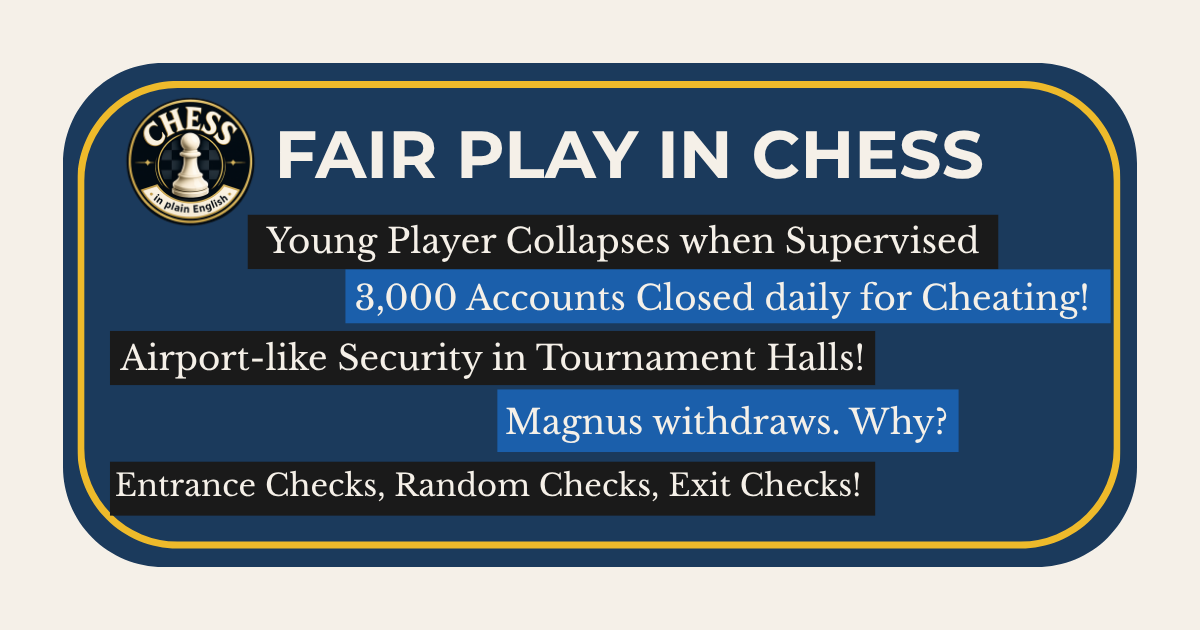
Chess fair play is under real strain. My son came second in a tournament that another young man had won — a player who performed significantly above his rating. At the next event he entered, the arbiter grew suspicious and closed the door to spectators. The player collapsed in a few moves and was expelled permanently.
Chess.com closes thousands of accounts every single day for fair play violations. This is the reality of chess integrity today.
Four levels of chess conduct
Chess conduct operates on four levels, each building on the one below. Integrity — the foundation of chess fair play — is what this article covers. Above it are formal rules enforced with defined penalties by an arbiter. Above that is etiquette, expected but not formally enforced. At the top is sportsmanship, upheld only by the culture of the game. The line in chess is clear: studying with an engine between games is legal; using one during a game is cheating. Training harder than your opponent is legitimate; having a friend signal moves from the spectator area is not. Cheating is not just a rule violation — it is taking an unfair advantage over every player in the event who chose to compete honestly.
Most players will never break a formal rule, let alone cheat outright. But almost every serious player has, at some point, brushed against the etiquette or sportsmanship layers — a sigh after a blunder, a slightly delayed handshake after a tough loss. Understanding all four levels helps you see cheating for what it is: not a grey area, but a clear, deliberate step below everything else on this list.
Online cheating — the scale
Chess.com closes 3,000 accounts per day for fair play violations. Not per month — per day. Lichess runs comparable detection systems. The method is almost always engine assistance: using a chess engine to select your moves during a game. The technical barrier is low — a second device, a browser tab, a third party feeding the moves. Both platforms run statistical systems that compare a player’s moves against engine output across multiple games. Unusually high correlation triggers a review. Neither platform publishes its exact methodology, because doing so would help cheaters evade detection.
The scale of the problem is part of why online platforms invest so heavily in detection rather than relying on players to report each other. A system reviewing every game, automatically, catches far more than a community of players ever could on its own. Even so, detection is a constant arms race — as detection methods improve, so do the methods used to evade them, which is exactly why neither platform reveals how its systems actually work.
Over-the-board cheating — how it works
Over-the-board cheating requires a communication channel — a way to get engine recommendations from a device to the player at the board. Most often the tool is a concealed phone. Methods include vibrating devices giving coded signals, earpieces, accomplices in the spectator area, and bathroom visits with a hidden device. A story from chess in Ireland: an adult player became convinced his teenage opponent was cheating — visiting the toilet frequently and returning with a brilliant move each time. The adult followed the teenager, found him with a phone, and physically removed him. Result: the cheating player was expelled. But so was the adult who confronted him. The correct response is always the same — speak to the arbiter discreetly.
Modern anti-cheating measures at serious events exist precisely because these methods are not hypothetical — they have all been used, and caught, at real tournaments. The arbiter is trained to notice unusual patterns: repeated bathroom visits timed suspiciously with difficult positions, a player who seems to consult something before returning to the board. Reporting a suspicion, quietly and through the proper channel, protects everyone in the event — including, ultimately, the player being suspected, if they turn out to be innocent.
The Niemann-Carlsen affair
In September 2022, Magnus Carlsen lost to Hans Niemann at the Sinquefield Cup and then withdrew from the tournament. He made no explicit accusation. The chess world understood the implication immediately. Niemann acknowledged cheating online twice as a teenager. Whether over-the-board cheating occurred was never conclusively proven. Niemann sued Carlsen, Chess.com, and others for defamation. The lawsuit was settled out of court. The affair forced a serious public conversation about anti-cheating infrastructure that the chess world had been deferring — and measures that had been discussed for years were accelerated.
The case remains genuinely contested in the chess world. Niemann’s supporters point to the lack of proven over-the-board cheating; his critics point to the confirmed online history and the statistical anomalies Chess.com identified. Both things can be true at once — a confirmed past violation does not prove a specific later game was also compromised, but it does explain why suspicion followed him so quickly.
Sandbagging and pre-arranged results
Not all cheating involves engines. Sandbagging is the deliberate suppression of your rating — losing games intentionally to stay below a threshold and compete in sections where you are stronger than the field. Detection relies on patterns: sudden dramatic performance above rated strength, inconsistent results that do not follow a normal development curve. ★ I had exactly that pattern myself recently — a genuine rise, then a genuine dip — and neither had anything to do with sandbagging. That is exactly what makes it so hard to prove: a real slump looks statistically identical to a faked one.
Pre-arranged results — agreeing a win, loss or draw before play begins — are most common in Swiss tournaments, where one player needs a specific outcome for a prize or title norm. Without direct evidence of intent, neither is easy to prove, which is why both remain among the most contested cases in fair play.
Organisers watch for both using similar tools: results that only make sense if a specific outcome was needed for a prize threshold or title norm, and pairings between players with a history of suspiciously convenient results. Neither sandbagging nor pre-arrangement involves an engine, which is exactly why it falls outside the statistical systems built to catch cheating online and over the board — human judgement from arbiters and organisers still matters as much as any software.
Anti-cheating at elite events
I led the Irish delegation to European and World Junior Championships on several occasions. Before competition, heads of delegation receive a briefing from the Fair Play officer describing a two-layer system.
The first layer is physical — checks at the entrance that feel like airport security, random checks during play and at the exit, no spectators in the playing hall, players unable to leave the playing area at any point with toilet facilities included for this reason.
The second layer is analytical — after rounds, games from strong performers are reviewed, comparing moves against engine recommendations and flagging unusually high correlation. A strong result is not suspicious on its own. A strong result where moves consistently match engine best play is a different matter.
The measures can feel excessive to players experiencing them for the first time — a young player asked to empty their pockets before a game can find it unsettling. But the alternative, an event where results cannot be trusted, is worse for every honest competitor in the room. Junior events take this particularly seriously, precisely because the players involved are still building their careers and their reputations.
Chess fair play consequences — the escalation
Confirmed cheating triggers a clear escalation. A first confirmed case results in a tournament ban and removal from the current event. More serious or systematic violations bring rating suspension — the player’s rating is frozen or withdrawn, preventing participation in rated events until the case resolves. At the top: permanent expulsion. A small number of players have received lifetime bans from FIDE or their national federation. Online platforms close accounts and adjust affected opponents’ ratings. Detection has improved significantly and continues to improve. The gap between what can be detected and what can be proven remains the place where the most difficult cases live.
Reinstatement, where it happens at all, typically requires a period of ineligibility and, in some federations, a formal review before a player is allowed to compete again. For a young player, the damage often extends well beyond the ban itself — a confirmed case follows a player’s reputation through the chess community for years, in a way that is far harder to repair than the suspension itself.
FAQ
How does Chess.com detect cheating?
Chess.com uses statistical systems that compare a player’s moves against engine recommendations across multiple games. Unusually high correlation — meaning your moves consistently match what a computer would play — triggers a review. The exact methodology is not published to prevent cheaters gaming the system.
What security measures do chess tournaments use against cheating?
At major events, this means two layers: physical checks at the entrance and during play, with no spectators allowed in the hall, and analytical review afterward, comparing strong performers’ moves against engine recommendations. Junior events take it just as seriously as elite ones.
What happened in the Niemann-Carlsen alleged cheating case?
In 2022, Magnus Carlsen withdrew from the Sinquefield Cup after losing to Hans Niemann, implying he suspected cheating without stating it directly. Chess.com’s report suggested Niemann had potentially cheated in over 100 online games. Over-the-board cheating was never proven. Niemann sued for defamation; the case settled out of court.
What is the penalty for cheating in a chess tournament?
Penalties escalate from a tournament ban for a first confirmed case, to rating suspension preventing participation in rated events, to permanent expulsion from FIDE or the national federation for the most serious cases. Online platforms close accounts and adjust affected opponents’ ratings.
How do people cheat at chess?
Mostly by getting engine assistance during a game. Online, that usually means a second device or browser tab feeding moves in real time. Over the board, it is most often a concealed phone, accessed during bathroom breaks — though vibrating devices and accomplices in the crowd are also used.
If you found this useful, join the Chess Dad list — chess in plain English, direct to your inbox.
Leave a Reply