
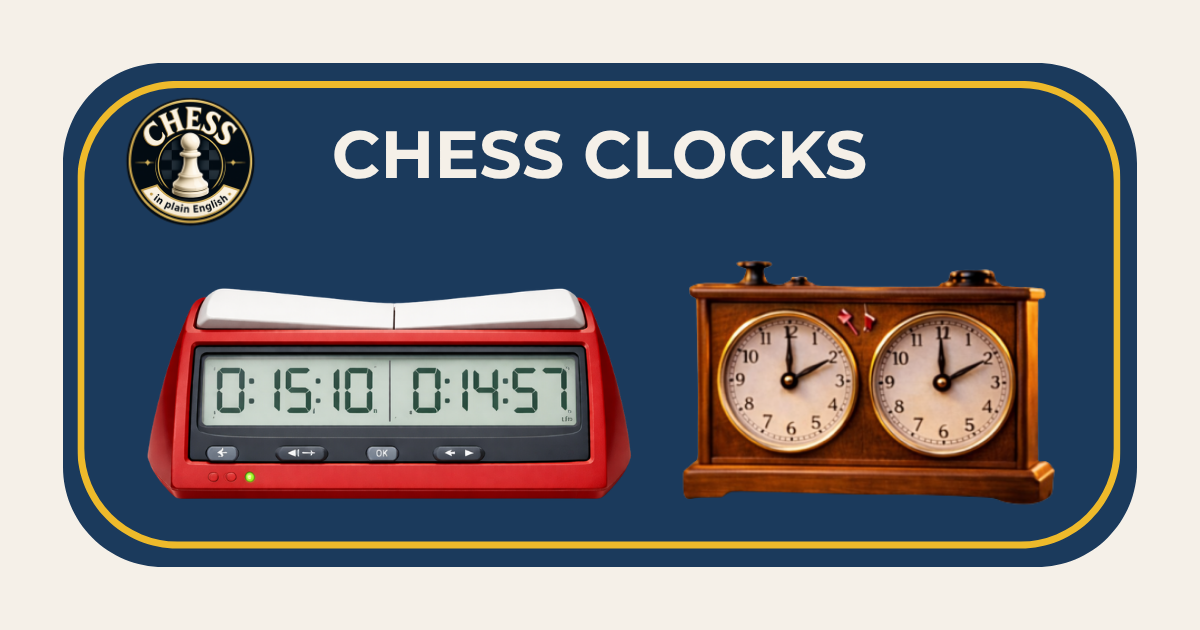
Chess clock rules decide far more of a game than most players realise — the clock is the tool that made chess a sport in the first place. Before it appeared in the 1880s, games could last indefinitely; players took hours per move and some matches stretched across multiple days. The first mechanical clocks changed everything: thinking time became a limited resource, and chess became a game where both skill and time management determined the result.
Contents
- From mechanical to digital chess clock
- Base time and increment
- Delay — how it differs from increment?
- Multi-stage time controls
- The correct sequence for pressing the clock
- What happens when you run out of time?
- Online clocks vs over-the-board
Chess clock rules: from mechanical to digital
The original mechanical chess clocks had two clock faces with a lever in the middle to switch between them. Each clock had a flag mechanism that fell when time expired — which is where the phrase ‘flag fall’ comes from, still used today even though modern clocks have no flags. These mechanical clocks ran on a single pool of base time with no addition. When it was gone, it was gone. Major FIDE events now require electronic digital clocks. Most rated tournament chess uses digital clocks, and seeing an analogue model at a rated event is increasingly rare.
Digital clocks solved a problem mechanical clocks could never handle well: increment. Adding a few seconds back after every move requires the clock to track each move individually and calculate in real time — something a mechanical lever and two clock faces simply cannot do. That single limitation is the real reason digital clocks became mandatory at serious events, not just convenience or modernisation for its own sake.
Base time and increment
Base time is your starting pool of thinking time for the entire game. In a 90+30 control, 90 minutes is the base. When your clock reaches zero, the game ends in a loss regardless of the position. Increment is the most important clock innovation in chess history. It adds seconds to your clock after each completed move. In a 15+10 game you receive 10 seconds back every time you press the clock. With increment you can never run out of time as long as you keep moving. Before increment became standard, over half of all decisive games ended in time loss rather than checkmate. Increment is also called Fischer time, after Bobby Fischer who popularised it.
This is why increment transformed the character of time trouble. Before it existed, the last few minutes of a long game often turned into a frantic scramble with almost no thinking involved. With increment, a player can still calculate properly even with little time on the clock, because every move buys back a few seconds of breathing room.
Delay — how it differs from increment?
Delay works differently from increment. Instead of adding time after your move, the clock pauses briefly before counting down. With a 5-second delay: move in 2 seconds and those 2 seconds are restored. Move in 8 seconds and only 5 are restored — you lose 3 seconds net. Time can never go up with delay, only stay the same or fall. The key difference from increment: delay prevents time loss for fast play but you cannot build a time reserve. Delay is named after Grandmaster David Bronstein who proposed it. In practice, delay is rarely used today — almost all modern tournament chess uses increment instead.
Delay was popular in the United States for years, particularly in scholastic chess, partly because early digital clocks supported it before increment became standard. Today, if you see delay at all, it is most likely on an older clock model still in circulation at a smaller club rather than a deliberate choice by the organiser. If your event’s regulations do not specify, assume increment — it is by far the more common standard worldwide now.
Multi-stage time controls
Some classical events use multi-stage time controls that allocate extra time at specific points in the game. A common format adds 30 minutes after move 40, giving players more time for complex endgames. The World Championship uses a more elaborate structure: 120 minutes for the first 40 moves, 60 additional minutes for the next 20, then 15 minutes for the rest of the game with a 30-second increment from move one. Multi-stage controls ensure players have adequate time for complex positions while guaranteeing the game eventually ends. They reward preparation and opening knowledge — reaching move 40 with significant time saved is a genuine advantage.
The logic behind multi-stage controls is straightforward: the opening and middlegame often move faster because players are following preparation or general principles, while complex endgames genuinely need more time to calculate accurately. Splitting the game into stages gives players that extra time exactly where it is most needed, rather than forcing them to budget ninety minutes across a game that might run to move sixty or seventy.
The correct sequence for pressing the clock
The rules around clock use are precise and enforced at rated events. The correct sequence every time: complete your move on the board and release the piece. Press the clock with the same hand that moved the piece. Record the move on your scoresheet. Three steps, in that order, every move. Violations that carry penalties include pressing before releasing the piece, using the piece to press the clock, pressing with the wrong hand, and hovering your hand over the clock while your opponent is thinking — this last one is considered intimidation and an arbiter can rule on it. An 8-year-old from my delegation lost a game at a European Championship for pressing with the wrong hand twice. The rule is enforced.
None of these violations are treated as minor technicalities at a serious event. The clock sequence exists to keep the game fair and unambiguous for both players, and arbiters are trained to watch for it, particularly in the closing stages of a game when players are under time pressure and most likely to cut corners.
What happens when you run out of time?
Losing on time is an immediate loss regardless of the position on the board. A queen and two rooks ahead — it does not matter. If your clock reaches zero, you lose. The narrow exception: if your opponent has insufficient material to force checkmate even in theory — a lone king, for example — the game is drawn rather than lost on time. Under five minutes remaining on your clock, you are generally no longer required to write down moves on the scoresheet in most formats. When time is critical, the game takes priority over the paperwork.
This is one of the harshest rules in chess, precisely because it has nothing to do with the position on the board. A player who has calculated brilliantly for three hours can still lose to a player who has played poorly but managed the clock better. Learning to manage your own time, not just your position, is a skill in itself — and one that separates strong tournament players from strong casual players almost as much as chess ability does.
Online clocks vs over-the-board
Online chess removes the physical elements of clock use entirely. The clock switches automatically, wrong-hand violations are impossible, and pre-moves — queuing your next move during your opponent’s time — change the dynamics of time pressure significantly. A player in time trouble online can survive almost indefinitely by pre-moving. Over the board that option does not exist. The result is that the same time control feels different on the two surfaces. I played 5+0 online for years without difficulty. Then I played 5+0 over the board, and it felt like bullet. The physical demands — pressing the clock and moving pieces — consume time that online play does not require.
This gap is worth planning for if your only chess experience so far has been online. Do not assume your online blitz rating tells you how you will handle a live clock under real time pressure — the physical mechanics of over-the-board play add a layer of difficulty that online practice simply does not prepare you for.
What is increment in chess clocks?
Increment is a fixed number of seconds added to your clock after each move you complete. In a 10+5 game you receive 5 seconds back every time you press the clock. Increment prevents the game from becoming pure hand-speed once players get low on time.
What hand do you press the chess clock with?
You must press the clock with the same hand you used to move the piece. Using the wrong hand is a rules violation. At FIDE events, the first offence adds two minutes to your opponent’s clock. A second offence in the same game is an automatic loss.
What happens if you forget to press the clock in chess?
Your clock continues counting down. Your opponent is under no obligation to tell you. It is your responsibility to press the clock after every move. Both players forgetting is rare and the arbiter may intervene, but this is not guaranteed.
What does flag fall mean in chess?
Flag fall originally referred to the flag mechanism on mechanical clocks that dropped visibly when time expired. The phrase is still used today to mean losing on time, even though modern digital clocks have no flags.
Can you lose on time when you are winning in chess?
Yes. Losing on time is an immediate loss regardless of position, with one exception: if your opponent has insufficient material to force checkmate even theoretically — such as a lone king — the result is a draw rather than a loss.
| If you found this useful, join the Chess Dad list — chess in plain English, direct to your inbox. |
Leave a Reply