
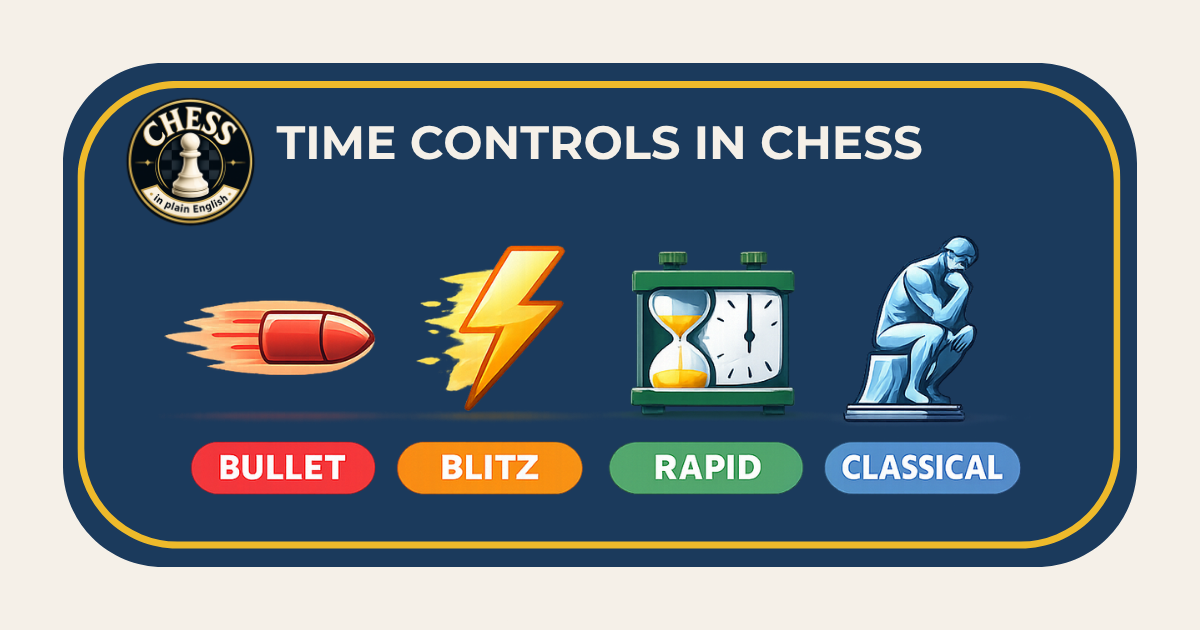
A time control defines how much thinking time each player has in a game. It is written as two numbers separated by a plus sign. 90+30 means you start with 90 minutes on your clock and receive 30 seconds back after every move you complete. 5+0 means five minutes total, no addition. The time control shapes the entire character of the game — the pace, the type of decisions you make, and what skills determine the outcome.
Contents
- What do time control numbers mean?
- Bullet time control — under three minutes
- Blitz time control — three to ten minutes
- Rapid time control — ten to sixty minutes
- Classical or standard time control — sixty minutes or more
- Online vs over-the-board — the same time control is not the same game
Chess Time Controls Explained: Bullet, Blitz, Rapid and Classical
Before clocks existed, chess games could last days. Players took hours per move. Some matches stretched across multiple sessions — it was psychological warfare, exhausting opponents through delay. Time controls transformed chess into a sport. They forced decisions. And made chess more interesting to watch, also.
What do time control numbers mean?
Every time control has the same format: base time in minutes, plus increment in seconds. Base time is your starting pool of thinking time for the entire game. Increment is added to your clock after each move you complete. In a 90+30 game, a player who makes 40 moves has received 20 minutes of increment — so effective thinking time is considerably longer than the base 90 minutes. In a 5+0 game there is no increment: when five minutes are gone, the game is over regardless of the position on the board.
The same shorthand works for any format — a bullet game might be written 1+0, a blitz game 3+2, a classical game 90+30. Once you know how to read the two numbers, you can look at any tournament’s regulations and immediately understand the pace of the event before you have played a single game. Some formats add a third stage, splitting the game into phases with different base times — those are covered later in this guide.
| Format | Time per player | Notes |
| Bullet | Under 3 minutes | Online only |
| Blitz | 3 to 10 minutes | Online and over-the-board |
| Rapid | 10 to 60 minutes | Online and over-the-board |
| Classical | 60 minutes or more | Serious over-the-board — the basis for FIDE titles |
Bullet time control — under three minutes
Bullet chess runs under three minutes total per player. It is almost entirely intuition and muscle memory. At that pace you are calculating one or two moves ahead at most. Speed and pattern recognition dominate. Bullet is a different game from the chess played at tournament boards — exciting and genuinely fun to watch, but not representative of the decisions you make in rated over-the-board play. FIDE does not recognise bullet as an official format for rated over-the-board events. Online platforms built the category because millions of players enjoy it. Over the board, the physical demands make bullet nearly unplayable at that speed.
Online, bullet is enormously popular precisely because a game takes barely a minute or two from start to finish — you can fit a dozen games into a short break. That same speed is what makes it a poor training format for anything except raw pattern recognition and mouse or touchscreen speed. If your goal is genuine improvement, I would recommend avoiding bullet.
Blitz time control — three to ten minutes
Blitz runs from three to ten minutes per player. It blends instinct with quick calculation — enough time to spot basic tactics, not enough for deep calculation. This is where most online chess happens: 5+0, 3+0, 3+2. Over the board, blitz is a serious competitive format with FIDE-rated events and a World Blitz Championship. The rules are identical to classical chess but the pace is compressed. Losing on time is a routine part of the game at this level, not an edge case.
The World Blitz Championship draws the same elite field as classical events, played over dozens of games in a single day rather than a handful over two weeks — a completely different physical and mental test. At club level, blitz nights are usually the most social evenings on the calendar: games finish fast, so more people play more opponents, and the games themselves generate plenty to talk about afterward. Treat it as both a serious format and a social one — chess manages to be both at this speed.
Rapid time control — ten to sixty minutes
Rapid is where genuine chess improvement starts to happen. You have enough time to calculate a few moves ahead, see basic strategic ideas, and notice mistakes mid-game — without the game running for hours. The most popular time control globally is 10+0, accounting for roughly 40 percent of all online games played. For over-the-board practice, 15+10 is the better choice — the closest simulation of real tournament conditions at a manageable length. If you are going to focus on one time control for improvement, rapid is the right answer.
Because a rapid game rarely runs past forty-five minutes, it fits naturally into an evening or a lunch break in a way classical chess cannot. Many national rapid championships now carry serious prestige and prize funds of their own, not just as a warm-up for classical events. If you are choosing a single time control to build both calculation and pattern recognition without dedicating an entire day to a game, rapid is consistently the recommendation you will hear from coaches and titled players alike.
Classical or standard time control — sixty minutes or more
Classical is the format used at every serious rated over-the-board tournament. The standard time control for most open events is 90+30 — 90 minutes base time with a 30-second increment from move one. A typical game runs around three hours. World Championship games use a more complex structure: 120 minutes for the first 40 moves, additional time for subsequent phases, with a 30-second increment throughout. Classical chess requires deep calculation, long-term planning, and psychological stamina — the ability to maintain concentration across three hours is a separate discipline from the chess itself. In September 2025, FIDE began piloting Fast Classic at 45+30 instead of 90+30, still counting for the classical rating, as a bridge between online habits and full over-the-board requirements.
The extra thinking time is what allows the deep strategic planning classical chess is known for — the kind of multi-move plans that simply are not possible at faster speeds. It is also the format every FIDE rating and title norm is ultimately built on, which is why serious tournament players treat classical results as the primary measure of their strength, whatever their rapid or blitz rating says.
Online vs over-the-board — the same time control is not the same game
I played 5+0 for years online without difficulty. Then I played 5+0 in a live over-the-board tournament. It felt like bullet to me. Online chess is structurally faster: you click or drag pieces instantly, pre-moves execute automatically, there is no clock to press. A five-minute online game feels closer to a seven or eight-minute over-the-board game. This is why the same time control produces very different chess in the two environments, and why online ratings and over-the-board ratings diverge even when the nominal time control is identical.
Physically pressing a clock and reaching across the board to move a piece all take real seconds that a mouse click does not — see How the Chess Clock Works for the mechanics of pressing the clock itself. Multiply that across forty or fifty moves and the gap becomes significant. If you are preparing for your first over-the-board event of 5+0, playing a few faster online games like 3+0 is a reasonable way to adjust your instincts before the real thing.
What does 90+30 mean in chess?
It means each player starts with 90 minutes on their clock and receives 30 seconds added back after every move they complete. A game at 90+30 typically lasts two to four hours depending on the number of moves played.
What time control should a beginner start with?
Rapid — somewhere between 10+0 and 15+10 — is the right starting point. It gives enough time to think and learn from decisions without games dragging on. Avoid bullet until you have built pattern recognition through slower formats.
What is increment in chess?
Increment is the number of seconds added to your clock after each move you complete. In a 15+10 game you receive 10 seconds back every time you press the clock after moving. Increment prevents time pressure from making games degenerate into pure hand-speed once both players are low on time.
What is the standard time control for rated chess tournaments?
The most common standard is 90+30 — 90 minutes base time with a 30-second increment from move one. This is the format used at most FIDE-rated open tournaments worldwide, though some weekend events trim it slightly to fit more rounds into two days.
Is blitz chess good for improvement?
As a supplement, yes. As your primary format, no. Blitz builds speed and tactical awareness but also reinforces shortcuts that hurt you in slower chess. Play most of your games in rapid or classical and use blitz for fun and pattern training.
| If you found this useful, join the Chess Dad list — chess in plain English, direct to your inbox. |
Leave a Reply